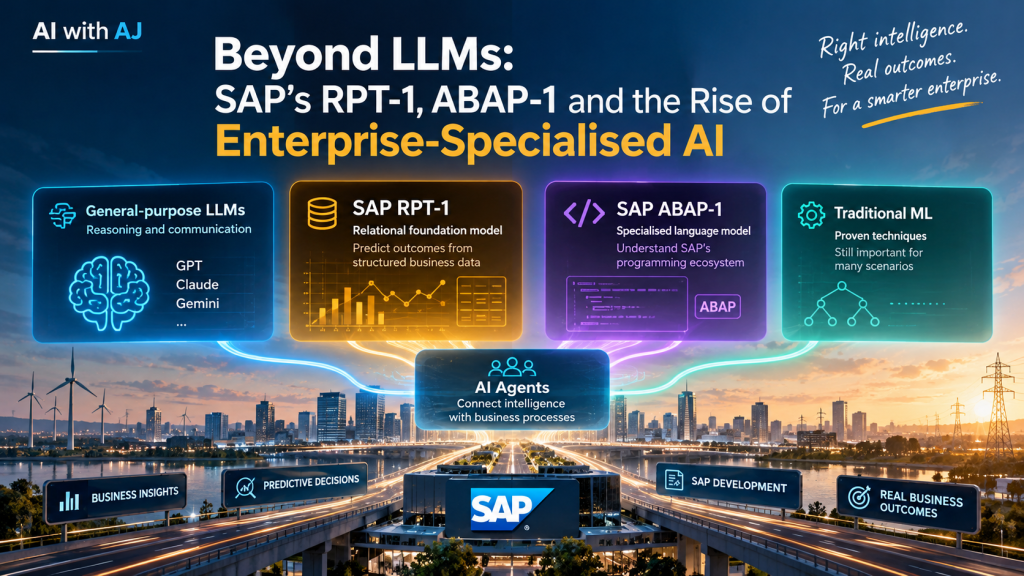
Not all foundation models are LLMs. And not all enterprise intelligence comes from language.
AI with AJ | October 2026
1. Does Every Enterprise AI Problem Really Need an LLM?
For the past few years, enterprise AI conversations have been dominated by Large Language Models (LLMs).
GPT, Claude, Gemini and other models have demonstrated remarkable capabilities in understanding language, generating content, writing software and reasoning through complex problems.
Naturally, enterprises have started asking:
How can we integrate LLMs into our business processes?
But I believe there is an even more important question:
Does every enterprise AI problem really need a general-purpose LLM?
Consider two scenarios.
A CFO wants to predict which customer invoices are likely to be paid late.
An SAP architect wants to understand 15 years of custom ABAP code before modernising an application for S/4HANA.
Both problems could benefit from artificial intelligence.
But the intelligence required is fundamentally different.
The first involves identifying patterns in structured business transactions. The second requires understanding a specialised programming language, its syntax, dependencies and enterprise application context.
This is where SAP’s two foundation-model initiatives — SAP RPT-1 and SAP ABAP-1 — become particularly interesting.
They represent two distinct approaches to enterprise intelligence.
And they raise a much bigger question:
Are we moving from the era of general-purpose AI towards an ecosystem of enterprise-specialised foundation models?
I believe we are.
2. First, Let’s Clarify: Are RPT-1 and ABAP-1 Also LLMs?
Before going deeper, we need to clear up a common misconception.
All LLMs are foundation models, but not all foundation models are LLMs.
A foundation model is pretrained on substantial amounts of data and can support multiple downstream tasks.
An LLM is a particular type of foundation model primarily designed to understand and generate language, including programming languages.
Let’s look at the difference.
| Model | Model category | Primary capability |
|---|---|---|
| GPT, Claude, Gemini | General-purpose LLMs | Language, reasoning, coding and multimodal tasks |
| SAP RPT-1 | Relational foundation model | Structured business data and predictive intelligence |
| SAP ABAP-1 | Specialised language/code model | ABAP code understanding and developer assistance |
SAP RPT-1 is not a conventional LLM.
It is designed to learn patterns from structured business data, including relationships across records and tables, and produce predictions.
SAP ABAP-1 is a specialised language model.
Its primary domain is ABAP code and the SAP development ecosystem, rather than general-purpose conversation.
This distinction matters because it challenges the assumption that every AI capability must begin with a conversational LLM.
3. SAP RPT-1: Teaching AI to Understand Business Data
Let’s start with RPT-1.
RPT stands for Relational Pretrained Transformer.
Traditional machine-learning solutions often require a separate development lifecycle for each prediction problem.
Suppose a company wants to predict whether a customer invoice will be paid late.
A typical approach might involve:
- Extracting historical invoice and payment data from SAP.
- Cleaning the data and engineering predictive features.
- Training and validating a classification model.
- Deploying the model into production.
- Monitoring accuracy, drift and performance over time.
Now imagine repeating that process for supplier delivery delays, customer churn, procurement risk and other business outcomes.
This creates a significant operational burden.
SAP RPT-1 introduces a different possibility.
Instead of training a separate model from scratch for every use case, a pretrained relational model can perform supported predictive tasks using structured data and relevant examples.
This is the promise of in-context prediction for enterprise data.
A practical example: Predicting late customer payments
Imagine an energy utility running SAP S/4HANA.
It processes thousands of customer invoices and payment transactions.
The finance team wants to identify which invoices are at risk of delayed payment.
Relevant information might include:
- Invoice amount and payment terms.
- Customer payment history.
- Outstanding balances.
- Customer segment.
- Historical payment delays.
- Other relevant transactional relationships.
An RPT-based solution could analyse these structured records and produce a prediction of late-payment risk.
The output might be a probability score such as 0.82, indicating an estimated 82% likelihood of a delayed payment.
This is an illustrative example, not a claim about a particular SAP deployment or a guaranteed level of predictive accuracy.
The score could then be passed to an enterprise workflow or AI agent.
For example:
RPT-1 predicts the risk. A general-purpose LLM explains the result in business language. An enterprise workflow coordinates an approved action.
This is where specialised predictive intelligence becomes operationally useful.
Does RPT-1 replace traditional machine learning?
Not necessarily.
Models such as XGBoost, LightGBM and specialised statistical techniques remain powerful options for structured data.
RPT’s value proposition is the potential to reduce task-specific training effort and accelerate the deployment of predictive capabilities across multiple business scenarios.
But enterprises should still compare performance, accuracy, cost, latency and data suitability against existing machine-learning approaches.
The right question is not whether RPT replaces machine learning.
It is whether a reusable pretrained model can deliver sufficient business value faster than building and maintaining a separate predictive model for every use case.
That is a much more meaningful enterprise discussion.
4. SAP ABAP-1: Teaching AI to Understand Enterprise Software
Now let’s look at SAP ABAP-1.
ABAP is not just another programming language.
For decades, organisations have used it to implement business rules, custom transactions, financial processes, procurement workflows, integrations and industry-specific logic.
In many enterprises, thousands of custom ABAP programs represent years of accumulated business knowledge.
The challenge is that much of this knowledge is embedded in code.
Documentation may be incomplete. Original developers may have moved on. Dependencies may be difficult to understand.
And when organisations modernise their SAP environments, they must decide which customisations to retain, redesign or eliminate.
This is where an ABAP-specialised language model becomes valuable.
SAP ABAP-1 is designed to understand the language and patterns of SAP software development.
Its initial documented capability focuses on explaining ABAP code, rather than autonomously generating and deploying complete enterprise applications.
A practical example: Understanding legacy ABAP
Imagine a utility company preparing to modernise a heavily customised procurement application.
The application contains thousands of lines of ABAP developed over 15 years.
A developer discovers a complex function module with multiple database operations, conditional rules and custom exception handling.
Traditionally, understanding this code could require extensive manual investigation.
With ABAP-specialised AI assistance, a developer could ask:
“Explain the business logic implemented in this ABAP program, identify its key dependencies and highlight areas requiring further investigation.”
The model could help explain the code’s structure and behaviour.
The developer would still need to validate the explanation, investigate dependencies and apply appropriate SAP development checks.
But the potential productivity improvement is significant.
What about GitHub Copilot and other AI coding assistants?
This is where the discussion becomes interesting.
General-purpose coding assistants such as GitHub Copilot can already support ABAP development in suitable environments.
So why does SAP need ABAP-1?
The answer is specialisation.
A general-purpose coding assistant learns from a broad range of programming languages and development patterns.
An ABAP-specialised model is designed around SAP-specific syntax, programming conventions and code structures.
However, specialisation does not automatically guarantee superior performance.
Organisations should evaluate both approaches against representative development tasks.
And it is important to distinguish the underlying model from the developer tools that expose it.
SAP ABAP-1 is a model. Joule for Developers and GitHub Copilot are developer-assistance experiences with their own capabilities, integrations and model choices.
They should not be treated as interchangeable products.
5. What’s New in 2026: SAP Is Moving Beyond Individual Foundation Models
One of the most interesting developments in 2026 is that SAP’s foundation-model strategy is evolving beyond individual models towards an integrated enterprise AI ecosystem.
SAP RPT-1.6: Advancing Predictive Intelligence
SAP’s October 2026 AI release highlights introduced RPT-1.6, with improvements in prediction quality, explainability and support for larger reference datasets.
SAP also introduced tabular orchestration capabilities intended to simplify how developers incorporate relational predictions into enterprise AI applications.
This is important because predicting a business outcome is only the first step.
Enterprises also need to integrate those predictions into operational processes.
Imagine an AI procurement agent identifying a supplier delivery risk.
The prediction becomes valuable when the agent can explain the risk, evaluate alternative actions and initiate an approved business workflow.
SAP ABAP AI: Moving Towards Agentic Development
SAP’s ABAP AI strategy is also expanding beyond code explanation.
Developments such as the ABAP MCP Server aim to make SAP development capabilities accessible to compatible AI coding assistants through governed interfaces.
This creates opportunities for AI-assisted development workflows involving code understanding, development tools and controlled engineering actions.
However, we should distinguish between the SAP ABAP-1 model itself and the broader ecosystem of developer tools, agents and integrations.
Not every capability available through Joule, an MCP server or a coding assistant should be attributed directly to ABAP-1.
Why This Matters
These developments point towards a broader enterprise AI architecture.
Specialised models provide focused intelligence. General-purpose LLMs provide reasoning and communication. Agents and enterprise services connect those capabilities to business processes.
The opportunity is not simply to deploy more AI models.
It is to build an intelligent enterprise architecture in which the right form of intelligence is applied to the right business problem.
6. The Bigger Picture: From One LLM to Multiple Specialised Models
Now comes what I consider the most important architectural implication.
Many early enterprise GenAI solutions followed a relatively simple pattern:
User → LLM → Enterprise Data → Response
That architecture works for many knowledge-assistance and conversational use cases.
But enterprise AI is evolving beyond question answering.
Organisations increasingly want AI systems that can predict, reason, recommend and execute business processes.
These capabilities do not necessarily belong in one model.
Consider a future enterprise architecture with three distinct intelligence capabilities.
Language intelligence
General-purpose LLMs such as GPT, Claude and Gemini provide natural-language understanding, reasoning, summarisation and interaction.
Business-data intelligence
Relational foundation models such as SAP RPT-1 provide predictions from structured business data.
Software intelligence
Specialised language models such as SAP ABAP-1 support understanding and maintaining enterprise software.
These capabilities can be combined through application services, APIs, orchestration and AI agents.
The architecture could look like this:
Business User / Enterprise Application
↓
AI Agent or Orchestration Layer
↓
Specialised Intelligence Services
- General-purpose LLM — reasoning and communication.
- SAP RPT-1 — structured-data predictions.
- SAP ABAP-1 — ABAP code understanding for development workflows.
↓
Enterprise Systems and Data
SAP S/4HANA | SAP BTP | Business Data Cloud | Other Enterprise Platforms
This is a conceptual reference architecture, not a claim that SAP currently delivers these components as one preconfigured solution.
It illustrates a broader principle:
The future enterprise AI architecture may be multi-model by design.
And the most important architectural decision may no longer be simply which LLM to select.
It may be which intelligence capability is best suited to each business task, and how those capabilities should be governed and orchestrated.
7. What Could This Mean for Energy and Utilities?
Let’s consider a realistic industry scenario.
An energy utility manages thousands of assets, suppliers, work orders, invoices and maintenance activities through SAP.
The organisation wants to improve maintenance planning and procurement reliability.
A possible AI-enabled workflow could operate as follows.
Step 1: Predict procurement risk
A relational foundation model evaluates structured procurement and supplier data to estimate the likelihood of delayed material deliveries.
Step 2: Assess operational impact
An application combines the risk prediction with maintenance schedules, equipment criticality and inventory availability.
Step 3: Explain the business situation
A general-purpose LLM helps translate the evidence into an explanation for the maintenance planner.
Step 4: Recommend actions
An AI agent proposes alternatives, such as identifying another approved supplier, reviewing inventory or rescheduling a non-critical maintenance activity.
Step 5: Execute with governance
Approved actions are carried out through SAP business APIs and established workflows, with authorisation, validation and audit trails.
Where does ABAP-1 fit?
It supports a different part of the lifecycle.
The SAP engineering team may use ABAP-specialised assistance to understand and modernise custom applications that support these processes.
In other words, RPT and ABAP-1 are complementary, but they are not necessarily runtime components of the same business agent.
RPT can contribute to business decision intelligence. ABAP-1 can contribute to the engineering intelligence needed to maintain and modernise the systems behind those decisions.
That distinction matters.
8. Why This Matters for SAP’s Clean Core Strategy
SAP customers are increasingly focused on clean-core principles.
The objective is to minimise unnecessary modifications to standard SAP applications, use released extension points and APIs, and develop appropriate extensions using modern SAP technologies.
But clean core is not just a technical architecture exercise.
It is also a knowledge problem.
Before modernising a legacy SAP application, architects need to understand what the existing code actually does.
Which business rules are embedded in custom programs?
Which modifications are still required?
Which functions can be replaced by standard SAP capabilities?
Which extensions should move to ABAP Cloud or SAP BTP?
ABAP-specialised AI could help accelerate the understanding and assessment of existing code.
At the same time, relational foundation models could help organisations build predictive capabilities around enterprise data without embedding every analytical function into traditional application logic.
I see an important connection here.
Clean Core simplifies the enterprise application landscape. Specialised AI models can help organisations understand that landscape and build new intelligence around it.
However, neither model automatically makes an SAP environment clean-core compliant.
Architecture standards, released APIs, security controls, developer review and lifecycle governance remain essential.
9. Are Specialised Foundation Models the Future of Enterprise AI?
I believe they will become an increasingly important part of enterprise AI architectures.
But I would caution against assuming that specialised models will replace general-purpose LLMs.
In fact, I expect the opposite.
General-purpose LLMs and specialised foundation models are likely to become more complementary.
The general-purpose LLM may remain the primary conversational and reasoning interface.
Specialised models may provide capabilities such as structured prediction, domain-specific code understanding and other focused forms of intelligence.
Traditional machine-learning models will also remain relevant where they deliver better results.
The enterprise AI landscape is therefore unlikely to converge on one universal model.
It is more likely to evolve towards a portfolio of models selected according to business requirements.
This raises several architectural questions:
- How do we select the appropriate model for a particular task?
- How do we compare specialised models with traditional ML and general-purpose LLMs?
- How do we manage access to sensitive enterprise data?
- How do we monitor accuracy, performance, cost and model drift?
- How do we integrate these models into governed enterprise workflows?
These are not just data-science questions.
They are enterprise architecture, operating-model and governance questions.
10. What Should SAP Customers Do Now?
My recommendation would be to start with focused experimentation rather than a large-scale transformation programme.
For SAP RPT-1, select a measurable prediction problem such as late payment risk, supplier delivery risk or another supported business classification task.
Compare its performance with an existing baseline such as XGBoost or a conventional statistical model.
Measure not only predictive accuracy but also implementation effort, operational cost and integration complexity.
For SAP ABAP-1, select a representative sample of legacy custom code.
Evaluate the accuracy and usefulness of code explanations, including how well they help developers understand business logic and dependencies.
Compare the results with existing development practices and available AI coding assistants.
For both models, verify availability, licensing, supported environments, data-access controls and integration options before designing a production solution.
Most importantly, treat these models as potential components of a broader enterprise AI architecture, not isolated technology experiments.
11. My Perspective: The Next Competitive Advantage May Be Model Specialisation
For years, the technology industry has been fascinated by model size, benchmark scores and the race to build increasingly capable general-purpose AI.
Those developments remain important.
But enterprise value is measured differently.
A CFO does not need the largest model in the world.
The CFO needs reliable predictions that improve working capital.
An SAP architect does not necessarily need a model that understands every programming language equally well.
The architect needs accurate assistance that reduces the time and risk involved in understanding complex SAP applications.
A maintenance planner does not need an impressive chatbot.
The planner needs actionable intelligence that helps avoid operational disruption.
That is why SAP’s RPT-1 and ABAP-1 deserve attention.
Not because they make general-purpose LLMs obsolete.
But because they demonstrate a potentially important shift towards AI models designed for specific enterprise problems.
The next competitive advantage in enterprise AI may not come from having the biggest model. It may come from knowing how to combine the right models, the right business data and the right workflows.
And perhaps that is the real evolution we should be watching:
From general-purpose AI to enterprise-specialised intelligence.
AI with AJ — Exploring AI, enterprise architecture and the future of intelligent business.
What do you think? Will specialised foundation models become essential to enterprise AI architectures, or will increasingly capable general-purpose LLMs eventually absorb these capabilities?
References and further reading
- SAP Business AI release highlights, Q4 2025: https://news.sap.com/2026/01/sap-business-ai-release-highlights-q4-2025/
- SAP AI release highlights, Q3 2026: https://news.sap.com/2026/10/ai-release-highlights-q3-2026/
- SAP’s ABAP agentic AI roadmap: https://community.sap.com/t5/technology-blog-posts-by-sap/entering-the-new-era-of-agentic-ai-for-abap-development/ba-p/14394643
- SAP completes Prior Labs acquisition: https://news.sap.com/2026/07/sap-completes-prior-labs-acquisition/


Leave a Reply