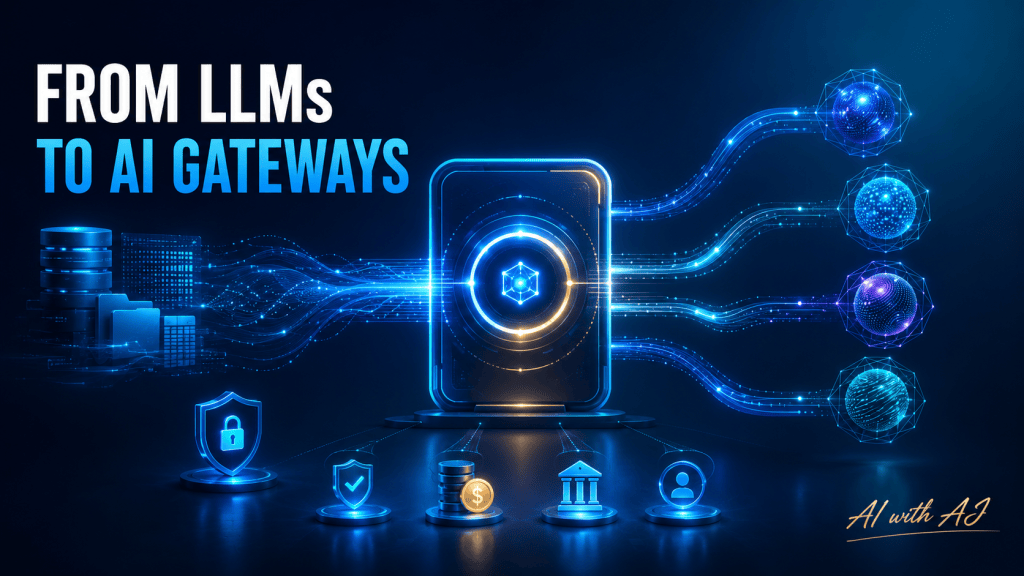
The future of enterprise AI will not be won by the smartest LLM. It will be won by the smartest orchestration.
For the past few years, enterprise AI conversations have revolved around one question:
Which Large Language Model should we choose?
Should it be GPT, Claude, Gemini, Llama, Phi—or another model that may arrive next month?
It is an understandable question. Model capability matters. But as organisations move from experimentation to production, I believe it is no longer the most important question.
A single enterprise may eventually operate hundreds of copilots and AI agents. Some requests will need deep reasoning. Others will require a simple classification, summary or data lookup. Some will contain confidential information. Some must remain within a particular geography. And some may not require an LLM at all.
Sending every request to the largest and most expensive model would be like using a highly paid strategy consultant to answer every telephone call, update every spreadsheet and check every invoice.
Technically possible? Yes.
Economically sensible? Probably not.
The better question is:
How can the enterprise decide, for every request, which model, data source, tool and policy should be used?
This is where the AI Gateway and intelligent model routing become important.
First, what is an AI Gateway?
An AI Gateway sits between enterprise applications and the AI services they use.
The application does not need to connect separately to every model provider or deployment. It sends its request through a common gateway, which can apply controls before and after the model call.
A production gateway may manage:
- authentication and access control;
- token quotas and rate limits;
- approved models and endpoints;
- content-safety policies;
- cost allocation and usage monitoring;
- prompt and response telemetry;
- caching, load balancing and failover;
- geographic and compliance restrictions.
Microsoft describes the AI gateway capabilities in Azure API Management as a way to secure, scale, monitor and govern the models, agents and tools behind intelligent applications. It can also provide one consistent interface across different AI back ends. (Microsoft Learn: AI gateway capabilities)
However, there is an important distinction:
The gateway governs the journey. The router chooses the model.
The two capabilities can work together, but they are not exactly the same thing.
So, what does the model router do?
Imagine an airport control tower.
The control tower does not fly the aircraft. It examines the situation and decides which runway, route and operating conditions are appropriate.
Similarly, a model router does not normally produce the final business answer. It analyses the request and selects an appropriate model from an approved pool.
For example:
- a routine classification may go to a small, fast model;
- a short summary may go to a cost-efficient model;
- a complex planning request may go to a frontier reasoning model;
- a sensitive request may be restricted to a privately hosted model;
- an unavailable deployment may trigger a permitted fallback.
Microsoft Foundry now provides a model router that is trained specifically to select a suitable model for each prompt. Its current documentation explains that the router analyses the full request—including system instructions, user messages, conversation history and tool definitions—and optimises across eligible models according to cost, quality and latency preferences. Microsoft also makes an important point: its router is a purpose-built machine-learning model, not another general-purpose LLM answering the user. (Microsoft Learn: How Model Router works)
This helps answer a question I frequently hear from architects:
Does the router have to call another LLM merely to decide which LLM to call?
The answer is no—not always.
How does the router actually make the decision?
There are four practical approaches.
1. Rules
The simplest router uses deterministic logic.
For example:
- if the task is translation and the input is below a token threshold, use Model A;
- if regulated personal data is detected, use only the approved private deployment;
- if the request requires vision, remove text-only models from the candidate list;
- if a model is unhealthy, use the approved fallback.
Rules are fast, transparent and easy to audit. They are particularly valuable for security and compliance because some decisions should never be left to probabilistic judgement.
2. A traditional classifier
A lightweight machine-learning classifier can label the request as summarisation, extraction, coding, question answering or analysis.
It can also estimate whether the request appears simple or complex. This costs less and adds less latency than asking a frontier LLM to classify every prompt.
3. A small language model
When the request is ambiguous, a small language model can act as a router.
It might return a structured decision such as:
{ "intent": "supplier_risk_analysis", "complexity": "high", "enterprise_data_required": true, "tools_required": ["SAP", "contract_search"], "model_tier": "advanced_reasoning"}
The small model is not answering the business question. It is performing a limited classification task.
4. A trained model router
A purpose-built router learns from large numbers of prompts and model-performance outcomes. It scores the available candidates and chooses the model expected to satisfy the configured objective.
For example, Microsoft Foundry currently offers Balanced, Cost and Quality routing modes. Balanced considers quality and cost together; Cost favours economical models more aggressively; Quality prioritises the strongest answer across the eligible pool. (Microsoft Learn: Model Router)
In practice, I believe mature enterprises will use a hybrid design: hard policies for security and compliance, health and quota checks for operations, and intelligent routing for the cost-quality decision.
A day in the life of one enterprise AI request
Let us take a practical example from procurement.
A buyer asks:
“Review our supplier’s performance over the last three years, explain why delivery reliability has deteriorated and recommend what we should address in the next negotiation.”
What happens next?
Step 1: Establish identity and entitlement
The gateway verifies who the user is and whether that person is authorised to access the supplier, contract and purchasing information.
Step 2: Apply data and security policies
The request is checked for sensitive information, permitted geography and approved model destinations. These controls should be driven primarily by enterprise policy and metadata—not by the LLM’s opinion.
Step 3: Understand the request
The router recognises that this is not a simple lookup. It involves comparison across time, causal analysis, multiple data sources and a business recommendation.
Step 4: Select the tools and retrieve evidence
The solution may query SAP for purchase orders and delivery history, retrieve contract terms from SharePoint and obtain quality incidents from a supplier-management system.
The LLM should not invent this information. The platform must retrieve it from systems of record.
Step 5: Select the model
A small model may be adequate for cleaning or classifying the records. But the final synthesis requires deeper reasoning, so the router selects a more capable model from the approved pool.
Step 6: Generate and validate the answer
The selected model produces the analysis using the retrieved evidence. The platform can then apply output-safety checks, citation requirements and business validation rules.
Step 7: Observe and learn
The gateway records latency, token consumption, model selected, cost, errors and user feedback. Over time, these observations improve routing policies and reveal where cheaper models perform just as well—or where escalation is necessary.
This is intelligent orchestration in action. The model is important, but it is only one participant in the journey.
What about token estimates, risk and required knowledge?
These signals do not all come from the same place.
| Routing signal | Likely source |
|---|---|
| Prompt and context size | The model’s tokenizer |
| User identity and role | Microsoft Entra ID or another identity provider |
| Data sensitivity | Microsoft Purview, source-system labels or enterprise metadata |
| Required business system | Tool registry, agent configuration, intent rules or semantic mapping |
| Model availability and latency | Operational monitoring and health telemetry |
| Budget and quotas | Gateway policies and cost-management data |
| Task intent and difficulty | Rules, classifier, small model or trained router |
| Response quality | Evaluations, human feedback and historical performance |
This table reveals an important architectural truth: the prompt alone is not enough.
A router may understand that the user wants a summary, but it cannot infer the user’s access rights, the sensitivity of a document or the organisation’s remaining budget simply by reading the words. Those signals must come from the wider enterprise control plane.
A practical example from Energy and Utilities
Consider a field engineer asking an assistant:
“Show me the isolation procedure for this transformer.”
The gateway may recognise a safety-critical context. It verifies the engineer’s identity and asset entitlement, restricts the request to approved operational data, retrieves the current controlled procedure, and selects a model approved for grounded summarisation.
Now consider a second question:
“Review five years of transformer failures, weather history and maintenance records, then recommend where we should prioritise investment.”
That request requires data engineering, analytics, perhaps forecasting, and more sophisticated reasoning. The platform may invoke specialised tools before asking an advanced LLM to explain the result.
The lesson is simple:
Not every AI request needs the same model—and not every business problem should be solved by an LLM alone.
Why this matters to the enterprise
Intelligent orchestration creates value in five areas.
Better economics
Routine work can use efficient models while expensive reasoning capacity is reserved for tasks that justify it.
Better resilience
Approved failover paths reduce dependence on a single deployment or provider.
Better governance
Policies can be applied consistently instead of being rebuilt independently inside every copilot and agent.
Better innovation
New models can be evaluated and added behind a stable enterprise interface without redesigning every application.
Better accountability
The organisation can observe which model was used, why it was permitted, how much it cost and whether it performed well.
My view: the AI Gateway is becoming an operating layer—not the entire operating system
It is tempting to call the AI Gateway the “operating system of enterprise AI.” It is a useful analogy, but I would qualify it.
The gateway is a critical control and access layer. The router is the model-selection layer. Agents and orchestration engines manage tasks and workflows. Enterprise data platforms provide context. Identity, security and governance services define the boundaries.
Together, these components begin to resemble an Enterprise AI Operating System.
The gateway is not the whole system, but it is increasingly the front door through which governed AI activity passes.
Final thoughts
The first phase of enterprise GenAI was about access to powerful models.
The next phase will be about using them intelligently.
Enterprises will not succeed by sending every task to the largest model, nor by chasing every new model release. They will succeed by building a flexible orchestration layer that understands the task, respects enterprise policy, retrieves trustworthy data, invokes the right tools and selects sufficient intelligence at a sensible cost.
So perhaps the strategic question is no longer:
“Which LLM should we standardise on?”
It is:
“How do we build an enterprise AI platform that continuously chooses the right model, the right tool, the right data and the right control for every request?”
That is the shift from LLM adoption to intelligent orchestration.
And, in my view, it is the next evolution of enterprise AI.
Key Takeaway
A powerful model can answer a difficult question. An intelligent AI platform knows whether that model should be called at all—and what must happen before and after the call.


Leave a Reply