The AI Story Nobody Is Talking About
For the past two years, the AI conversation has been dominated by Generative AI.
ChatGPT.
Copilots.
AI Agents.
Prompt Engineering.
Large Language Models.
Almost every boardroom discussion on AI eventually finds its way back to GenAI.
And rightly so.
Generative AI has transformed how people interact with information.
But if you walk into a utility control room, a refinery operations centre, an energy trading desk, a wind farm operations hub, or a grid management centre, you will discover something interesting:
The most valuable AI systems in the energy sector are often not Generative AI systems at all.
They are machine learning models.
Many of them have been operating quietly for years.
No flashy chatbot interface.
No conversational prompts.
No viral LinkedIn posts.
Just millions of predictions driving billions of pounds of business value.
As the industry rushes toward Agentic AI, it is worth remembering an important truth:
AI Agents are only as intelligent as the predictive engines behind them.
And those predictive engines are still powered by machine learning.
Why Energy Is Different
Unlike many industries, energy companies operate physical systems.
Pipelines.
Transformers.
Refineries.
Power plants.
Wind turbines.
Battery systems.
Transmission networks.
Gas distribution networks.
These assets generate enormous volumes of operational data every second.
The challenge is rarely creating content.
The challenge is predicting what happens next.
Will demand rise tomorrow?
Will a transformer fail next month?
Will a wind turbine underperform next week?
Will a customer default on payment?
Will a refinery margin improve if feedstock sourcing changes?
These questions are not solved by large language models alone.
They require prediction.
And prediction remains the domain of machine learning.
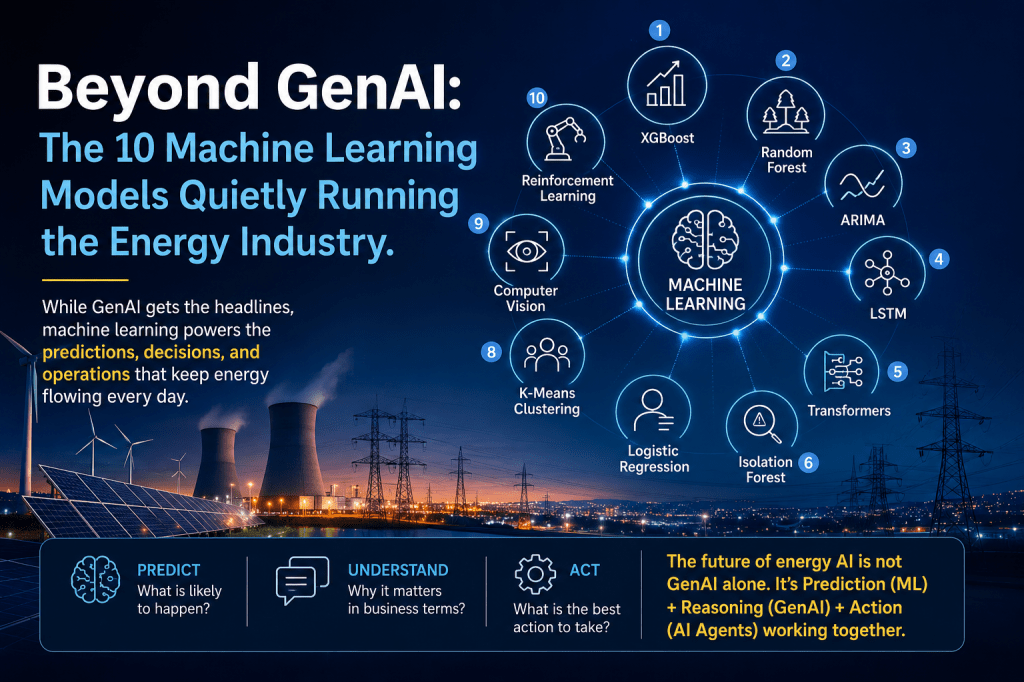
1. XGBoost – The Undisputed Champion
If there is one model that dominates industrial AI, it is XGBoost.
It is used because it consistently delivers strong predictive performance while remaining relatively interpretable.
Energy companies use XGBoost for:
- Asset failure prediction
- Customer churn prediction
- Demand forecasting
- Energy theft detection
- Debt risk assessment
- Maintenance prioritisation
When utilities want to know which transformer is likely to fail in the next 30 days, XGBoost is often the first model data scientists reach for.
It may not be glamorous.
But it works.
And in the energy sector, reliability usually beats novelty.
2. Random Forest – The Reliable Workhorse
Before XGBoost became popular, Random Forest was the industry’s favourite predictive model.
Even today it remains widely used.
It works particularly well when organisations need:
- Fast deployment
- Strong accuracy
- Explainability
- Limited tuning effort
Many utilities continue to use Random Forest models to predict equipment failures and customer behaviour.
Think of it as the Toyota Land Cruiser of machine learning.
Not always exciting.
Almost always dependable.
3. ARIMA – The Grandfather of Forecasting
Long before neural networks arrived, energy companies relied on ARIMA models.
Many still do.
ARIMA remains highly effective for forecasting:
- Electricity demand
- Gas demand
- Renewable generation
- Market prices
- Consumption trends
What makes ARIMA remarkable is its simplicity.
It doesn’t need millions of data points.
It doesn’t need GPUs.
Yet it continues to generate business value every day.
4. LSTM – Giving Memory to Forecasting
As forecasting challenges became more complex, traditional statistical methods began to struggle.
Energy systems are influenced by:
- Weather
- Seasons
- Economic conditions
- Human behaviour
- Market events
LSTM (Long Short-Term Memory) networks were created to handle long-term dependencies.
Unlike traditional models, LSTMs can remember patterns from far back in time.
Utilities use them for:
- Load forecasting
- Renewable generation forecasting
- Demand response optimisation
- Energy trading predictions
When forecasting becomes complicated, memory becomes valuable.
That is precisely what LSTM provides.
5. Transformers – The New Generation Forecasters
Most people associate Transformers with ChatGPT.
But their impact extends far beyond language.
Energy companies are increasingly using Time Series Transformers for:
- Grid forecasting
- Renewable generation prediction
- Commodity price forecasting
- Margin optimisation
These models can analyse thousands of variables simultaneously and identify complex relationships that traditional approaches often miss.
This is why many organisations are now moving from LSTM-based forecasting to Transformer-based forecasting.
6. Isolation Forest – Finding the Unknown
One of the biggest challenges in operations is identifying unusual behaviour before it becomes a problem.
Isolation Forest excels at anomaly detection.
It helps identify:
- Electricity theft
- Gas leakage
- Smart meter tampering
- Equipment degradation
- Cybersecurity incidents
The beauty of anomaly detection is that it does not need to know every possible failure scenario.
It simply identifies behaviour that looks unusual.
Sometimes that is enough to prevent a major incident.
7. Logistic Regression – Simplicity Still Wins
In an era of deep learning, Logistic Regression remains surprisingly relevant.
Why?
Because executives like explanations.
Regulators like explanations.
Auditors like explanations.
And Logistic Regression provides them.
Utilities commonly use it for:
- Customer churn prediction
- Debt risk scoring
- Fraud detection
- Payment default prediction
Sometimes the best model is not the most sophisticated.
It is the one the business trusts.
8. K-Means Clustering – Understanding Customers
Not all machine learning is about prediction.
Sometimes the goal is understanding.
K-Means helps energy companies group customers into meaningful segments.
Examples include:
- High consumption households
- Solar adopters
- EV owners
- Vulnerable customers
- Industrial consumers
This segmentation drives targeted products, services, and engagement strategies.
Without customer segmentation, personalisation becomes impossible.
9. Computer Vision Models – Teaching Machines to See
Energy companies are increasingly deploying cameras, drones, and inspection robots.
The challenge is analysing millions of images.
This is where computer vision models become essential.
Applications include:
- Power line inspections
- Wind turbine blade inspections
- Solar panel defect detection
- Refinery safety monitoring
- Asset corrosion detection
Instead of engineers manually reviewing thousands of images, AI identifies potential issues automatically.
Inspection becomes proactive rather than reactive.
10. Reinforcement Learning – Optimising Decisions
Perhaps the most exciting model category for the future is Reinforcement Learning.
Unlike prediction models, reinforcement learning focuses on decisions.
It continuously learns the best action to take in changing environments.
Applications include:
- Battery optimisation
- Energy trading
- Grid balancing
- EV charging optimisation
- Demand response programmes
As energy systems become increasingly dynamic, optimisation becomes as important as prediction.
The Future Is Not GenAI Versus Machine Learning
A common misconception is that Generative AI will replace machine learning.
It won’t.
In reality, they solve different problems.
Machine learning answers:
What is likely to happen?
Generative AI answers:
What should humans understand?
Agentic AI answers:
What action should be taken?
The future belongs to organisations that combine all three.
Imagine this scenario:
A machine learning model predicts a transformer has an 85% probability of failure.
A Generative AI system explains the risk in business language.
An AI Agent automatically creates the SAP maintenance order, checks spare parts availability, schedules a field engineer, and updates operational plans.
That is not one technology.
That is an ecosystem.
And machine learning remains the foundation.
Final Thoughts
The energy industry is entering its next AI chapter.
The headlines may belong to GenAI.
The demonstrations may belong to AI Agents.
But the operational intelligence that keeps grids stable, pipelines flowing, turbines spinning, and customers supplied is still largely powered by machine learning.
The most successful energy companies of the next decade will not choose between machine learning and Generative AI.
They will combine them.
Because prediction without action creates limited value.
And action without prediction creates risk.
The winners will be those who master both.
The future of energy AI is not GenAI alone.
It is Machine Learning, Generative AI, and Agentic AI working together.
And that future has already begun.
AI with AJ

 THE AI CHRONICLE
Leave a comment