For the last two years, enterprise leaders have been flooded with promises about AI.
AI agents will optimise operations. Computer vision will automate inventory. Autonomous systems will reduce manual work.
Intelligent automation will eliminate inefficiencies.
And to be fair, many of these technologies do work impressively in controlled environments. But then reality arrives. And reality is messy.
That is exactly what happened with Starbucks.
The AI System That Was Supposed to Fix Inventory Chaos
Starbucks introduced an AI-powered inventory system across North America as part of its broader effort to reduce supply shortages and improve store operations.
The system used:
- computer vision
- LiDAR scanning
- AI-based product recognition
- automated shelf counting
The objective sounded straightforward: help baristas spend less time manually counting inventory and improve replenishment accuracy.
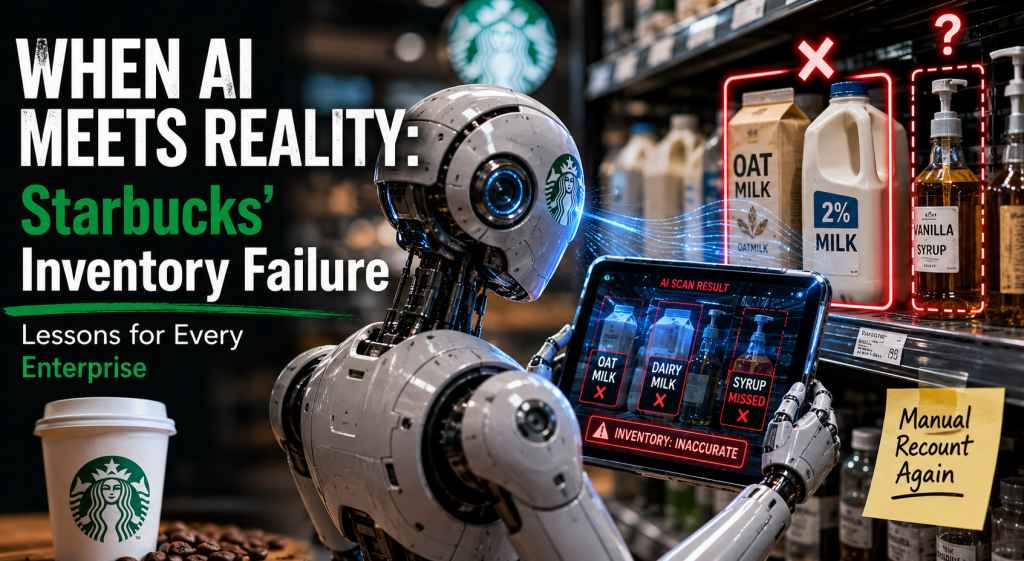
The technology came from a startup called NomadGo, whose platform used tablet-mounted cameras and AI models to identify products and count stock levels automatically.
On PowerPoint slides, this likely looked revolutionary. But enterprise AI does not live inside PowerPoint. It lives inside operational reality. And operational reality fought back hard.
What Actually Went Wrong
Reports suggest the system struggled almost immediately with real-world store conditions.
The AI repeatedly:
- confused dairy milk with oat milk
- failed to identify syrup bottles
- misread partially visible packaging
- generated inaccurate inventory counts
- triggered incorrect replenishment assumptions
Baristas reportedly had to manually recount products after the AI scans, creating more work instead of less.
Eventually, Starbucks decided to discontinue the system across North America. At first glance, this may appear to be a technology failure.
But the deeper story is far more important.
The Real Problem Was “Process Debt”
The Starbucks case exposes something many enterprises still underestimate. AI cannot repair broken operational foundations. It can only amplify them.
Reuters reporting indicated Starbucks was already struggling with:
- fragmented suppliers
- inconsistent inventory processes
- forecasting challenges
- operational bottlenecks
- ageing IBM AS/400-based legacy infrastructure
- inconsistent replenishment flows
This matters enormously. Because AI systems depend on operational consistency.
If processes are unstable…
AI becomes unstable.
If workflows vary by location…
AI accuracy deteriorates.
If master data is inconsistent…
AI recommendations become unreliable.
I often describe this as Process Debt.
Most enterprises focus heavily on technical debt:
old systems, outdated platforms, integration complexity. But Process Debt may become the far bigger challenge in the age of AI. Because even the smartest AI cannot compensate for operational fragmentation at scale.
The Physical World Is Harder Than the Digital World
One of the biggest misconceptions in enterprise AI today is assuming that success in digital workflows automatically translates into success in physical operations.
It does not.
Digital systems are relatively predictable:
- structured interfaces
- standardised data
- deterministic workflows
- stable environments
Physical environments are completely different:
- shelves move
- products change packaging
- lighting conditions vary
- humans improvise
- objects are partially hidden
- stores operate under pressure
- reality constantly changes
This is why computer vision in real-world environments remains one of the hardest AI problems.
The AI may perform brilliantly in a controlled pilot.
But enterprise scale introduces entropy.
And entropy destroys brittle automation.
Why This Matters Beyond Starbucks
Many executives may view this as simply a retail problem.
That would be a serious mistake.
Because the exact same pattern is emerging across industries.
Utilities.
Manufacturing.
Healthcare.
Oil & gas.
Supply chains.
Facilities management.
Everywhere, organisations are racing to deploy:
- AI agents
- copilots
- autonomous workflows
- intelligent operations
- predictive systems
But many of these environments still suffer from:
- disconnected systems
- fragmented workflows
- inconsistent processes
- poor data quality
- legacy operational models
And then leadership teams wonder why the AI struggles to scale reliably.
The uncomfortable reality is this:
Most enterprises do not yet have AI-ready operational foundations.
AI is exposing operational weaknesses that already existed.
It is simply revealing them faster.
The Bigger Enterprise Lesson
The Starbucks story may ultimately become one of the defining enterprise AI lessons of this decade.
Not because the AI was unintelligent.
But because enterprises are underestimating what operational AI truly requires.
Successful enterprise AI requires:
- stable processes
- workflow discipline
- operational standardisation
- clean master data
- exception handling
- human-centred design
- contextual awareness
- strong systems architecture
The future winners in AI may not necessarily be the companies with the largest models.
They may be the companies with the cleanest operational foundations.
AI Needs Operational Engineering, Not Just Prompt Engineering
The market today is obsessed with:
- models
- prompts
- agents
- copilots
- orchestration frameworks
But the harder challenge is operational engineering.
How do AI systems behave under real-world variability?
How do they manage ambiguity?
How do they recover from uncertainty?
How do humans intervene?
How do workflows adapt dynamically?
How do systems maintain trust under pressure?
These are operational architecture questions.
And this is where the next phase of enterprise AI maturity will be won or lost.
Final Thought
The Starbucks AI system could see the shelf.
But it could not understand the store.
And that distinction may define the future of enterprise AI.
Because eventually every AI system leaves the lab, exits the demo environment, and encounters operational reality.
And reality is always harder than the presentation slide.
Sources & References
Reuters – Starbucks scraps AI inventory tool across North America
Reuters – Inside Starbucks’ supply struggles: AI glitches, scattered suppliers and shortages

 THE AI CHRONICLE
Leave a comment