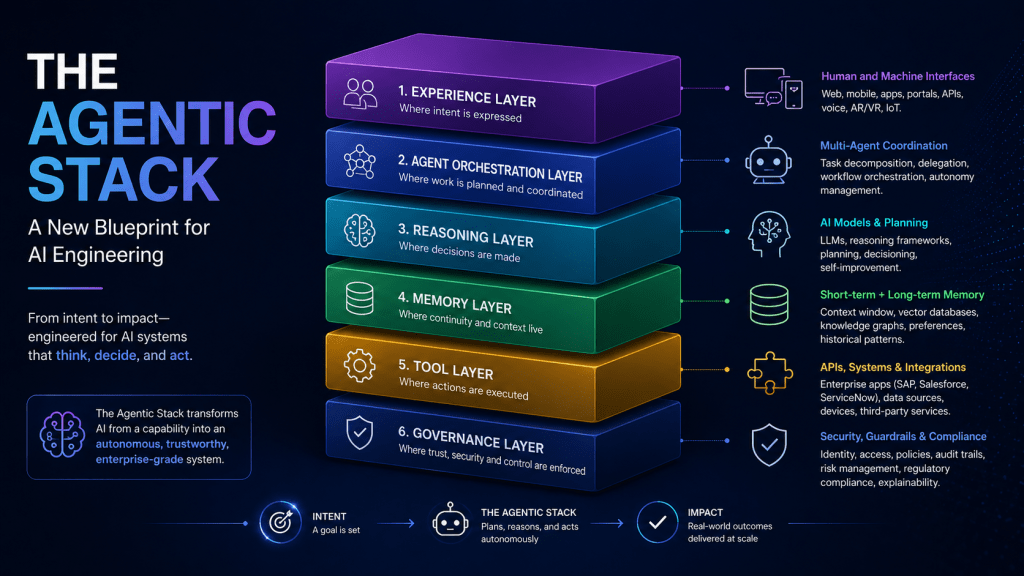
The Agentic Stack: A New Blueprint for AI Engineering
From copilots to autonomous systems—how enterprises must redesign engineering for AI that thinks and acts.
We’re Building the Future… Using the Past
Let me start with an uncomfortable truth:
We are trying to build autonomous AI systems using engineering principles designed for deterministic software.
That’s the problem.
Most AI initiatives today:
- Impress in demos
- Struggle in production
- Fail to scale
Because we didn’t just add AI to software.
We introduced non-determinism into engineering.
And that changes everything.
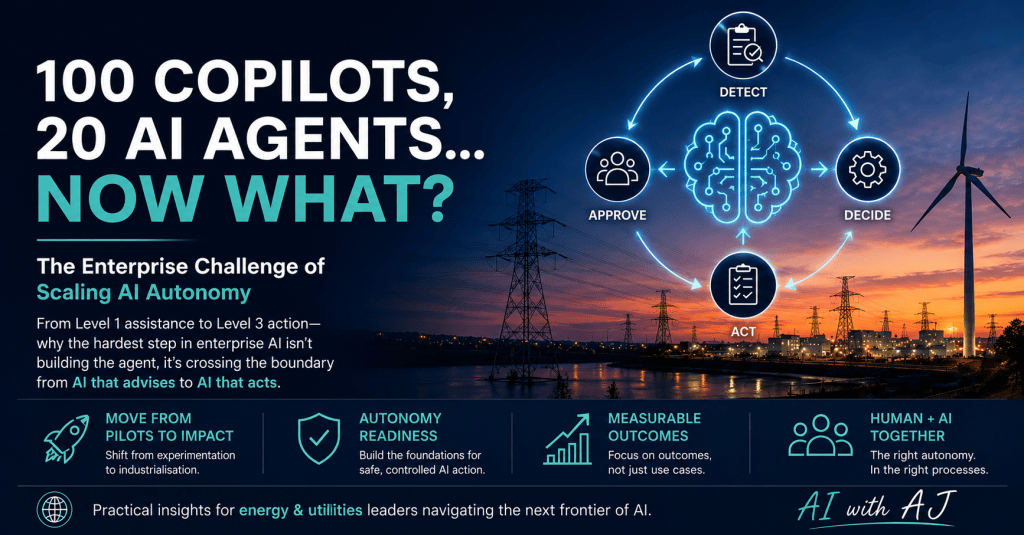
From Assistive AI to Agentic Systems
Today’s enterprise AI is largely:
- Chatbots
- Copilots
- Recommendation engines
They are useful—but they are still assistive.
They:
- Suggest
- Respond
- Generate
They don’t:
- Decide
- Act
- Execute autonomously
The real shift begins when AI stops saying “Here’s what you can do”…
and starts saying “It’s already done.”
Introducing the Agentic Stack
To build systems that can think, decide, and act, we need a new blueprint.
The Agentic Stack is that blueprint.
Not a tool.
Not a product.
But a design model for engineering intelligent, autonomous systems.
The Six Layers That Matter
1. Experience Layer — Where intent is expressed
Users (or machines) no longer navigate screens—they express intent through apps, APIs, or conversations.
2. Agent Orchestration Layer — Where work is coordinated
This is the core. It breaks down tasks, manages multiple agents, and balances autonomy with control.
3. Reasoning Layer — Where decisions are made
Powered by LLMs and planning frameworks, this layer handles contextual decision-making under uncertainty.
4. Memory Layer — Where context lives
Short-term and long-term memory (vector stores, knowledge graphs) enable continuity and learning.
5. Tool Layer — Where actions happen
This connects agents to enterprise systems like SAP, ServiceNow, and external APIs—turning decisions into execution.
6. Governance Layer — Where trust is enforced
Security, auditability, and compliance are critical—especially in regulated sectors guided by bodies like
Ofgem.
The Key Insight
Let’s simplify the shift:
Traditional software executes instructions.
Agentic systems make decisions.
That’s the difference.
And it means AI engineering is no longer just about models—it’s about system design.
Why This Matters: Energy Example
The impact becomes clearer in industries like energy.
Imagine:
- A tariff optimisation agent switching providers automatically
- A grid agent balancing supply and demand in real time
- An EV charging agent negotiating prices dynamically
These systems:
- Continuously learn
- Act autonomously
- Optimise outcomes
The grid doesn’t just become digital—it becomes agentic.
Where Enterprises Are Getting It Wrong
Most organisations are:
- Treating agents like APIs
- Ignoring memory architecture
- Over-investing in models
- Under-investing in orchestration
Which leads to:
“Smarter interfaces… but not smarter systems.”
What Leaders Should Do Now
If you’re serious about Agentic AI:
- Shift from use cases → agent ecosystems
- Invest in orchestration, not just models
- Design for agent-to-system interactions
- Build governance from day one
Final Thought
We often believe:
“Better models will solve the problem.”
They won’t.
The future of AI will not be built by better models.
It will be built by better engineering.
And that engineering starts with the Agentic Stack.
The Question That Matters
Are you building AI features…
or engineering systems that can make decisions and act on their own?

 THE AI CHRONICLE
Leave a comment