For the last two years, the enterprise AI conversation has largely been about adoption.
How many GenAI use cases have we identified?
How many copilots have we deployed?
How many AI agents are being developed?
But I am beginning to hear a very different question from customers.
“We already have copilots and AI agents. How do we move them to the next level of autonomy?”
I believe this is becoming one of the most important questions for enterprise AI — particularly in energy and utilities.
Because building an AI assistant is one thing.
Allowing AI to act on behalf of the enterprise is something very different.
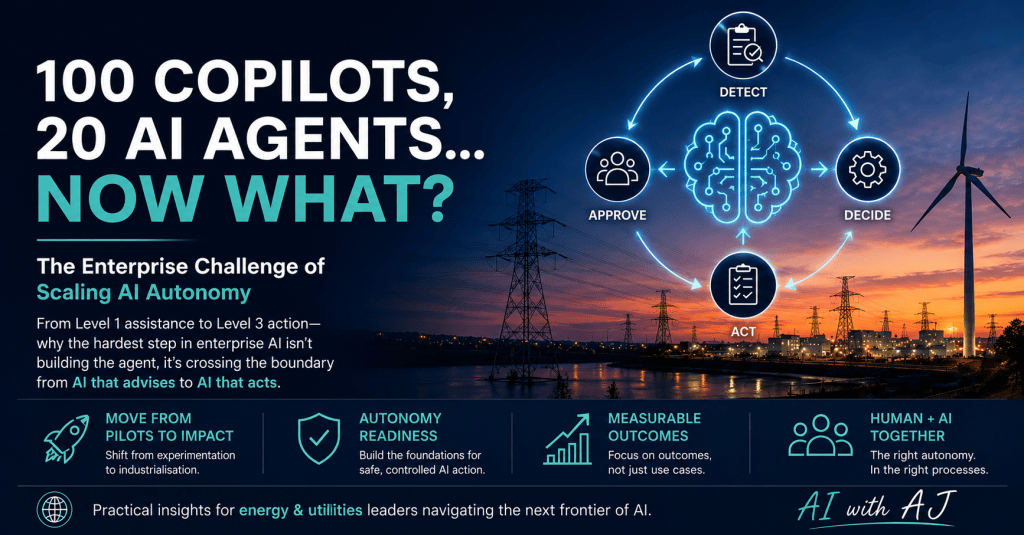
The Journey from AI Assistance to AI Action
It helps to think about enterprise AI through an autonomy curve.
Level 1 — Assist
AI helps employees find and understand information.
A field engineer might ask:
“Show me the maintenance history and operating procedure for Transformer T-102.”
The AI retrieves information from manuals, maintenance records and enterprise systems and provides an answer.
This is where many enterprise copilots started.
Level 2 — Recommend
Now AI begins analysing information and recommending what should happen next.
For example:
“Transformer T-102 has experienced repeated temperature excursions. Based on sensor trends, maintenance history and similar failures, an inspection is recommended within seven days.”
The AI is becoming more intelligent, but the human still makes the decision and performs the action.
Many organisations are becoming comfortable here.
But then comes Level 3.
And this is where things become much more interesting.
Level 3 Changes the Game
Imagine the same transformer scenario.
The AI detects the anomaly.
It analyses asset health and maintenance history.
It identifies the likely intervention.
But instead of simply recommending an inspection, the agent now starts preparing the action.
Detect anomaly → Assess risk → Check maintenance history → Identify intervention → Check crew availability → Create work order → Check spare parts → Request approval
Once approved, the workflow continues into the appropriate enterprise systems.
The AI is no longer simply answering questions.
It is participating in the business process.
This is an important boundary.
And crossing this boundary is proving much harder than many organisations initially expected.
The L2-to-L3 Problem Isn’t Just an LLM Problem
When an AI assistant is retrieving information or generating a recommendation, the architecture can be relatively straightforward.
Connect an LLM to enterprise knowledge, provide the appropriate context and implement suitable security.
But once an agent starts taking actions, a completely different set of questions emerges.
Identity: Who is the agent acting as?
Authorisation: What exactly is the agent permitted to do?
Tools: Which APIs and enterprise systems can it invoke?
Approval: Which decisions require a human?
Guardrails: What happens if the agent tries something outside its permitted boundary?
Observability: Can we see what the agent decided, why it decided it and what tools it called?
Audit: Can we reconstruct the complete chain of actions six months later?
Recovery: Can an action be stopped or reversed?
Accountability: Ultimately, who owns the decision?
These questions become particularly important in energy and utilities, where AI may interact with operational assets, customer processes, regulatory obligations and safety-critical workflows.
That is why I believe:
Moving from Level 2 to Level 3 is not primarily an AI-model problem. It is an enterprise operating-model problem.
We Need an Autonomy Readiness Stack
Before moving a process towards greater autonomy, organisations need to assess whether the surrounding enterprise environment is actually ready for it.
I think about this as an Autonomy Readiness Stack.
At the top is the business process. Is the process sufficiently understood and standardised?
Then comes the agent and reasoning layer. What decisions is the AI expected to make?
Below that are tools, APIs and enterprise systems such as SAP, asset-management platforms, CRM, workforce management and operational data platforms.
Then come identity and permissions. The agent should have only the authority necessary for the task.
Around all of this sit human approvals and guardrails, defining exactly where autonomy stops.
And finally, organisations need observability, auditability and governance so that every important AI decision and action can be understood and controlled.
Without these foundations, increasing autonomy can simply increase enterprise risk.
Not Every Process Needs Level 4 or Level 5
There is another important point.
The objective should not be:
“How do we make every AI agent fully autonomous?”
That would be the wrong target.
The objective should be:
“What is the right level of autonomy for this business process?”
A knowledge assistant may remain at Level 1.
An engineering diagnostic assistant may operate at Level 2.
A maintenance agent might operate at Level 3 — preparing actions automatically but requiring approval before execution.
Some highly standardised, low-risk processes may eventually operate with much greater autonomy.
In safety-critical environments, however, human authority may remain essential.
More autonomy is not automatically better AI. Appropriate autonomy is better AI.
From AI Proliferation to AI Industrialisation
This is why I believe the enterprise AI conversation is changing again.
The first phase was experimentation.
Organisations built copilots, RAG applications, predictive models and GenAI proofs of concept.
The second phase became proliferation.
Different business units started building their own copilots and agents.
Now we are entering the third phase:
AI industrialisation.
And industrialisation requires more than better models.
It requires reusable agent capabilities, enterprise integration, identity, governance, observability, cost management and an operating model for humans and AI agents working together.
Soon, asking an organisation “How many AI agents do you have?” may be as meaningless as asking “How many APIs do you have?”
The more useful questions will be:
What business outcomes are those agents delivering?
What level of autonomy have they been trusted with?
And can the organisation safely govern that autonomy?
The Question for 2026
For CIOs, CTOs and business leaders in energy and utilities, I believe the next AI challenge is becoming clear.
It is no longer simply:
“Where can we deploy another copilot?”
It is:
“Which business processes are genuinely ready to move from AI assistance to controlled AI action?”
Because the hardest step in enterprise Agentic AI may not be building the agent.
It may be crossing the boundary from AI that advises to AI that acts.
And organisations that learn how to cross that boundary safely, incrementally and economically may ultimately capture the real value of Agentic AI.


Leave a comment