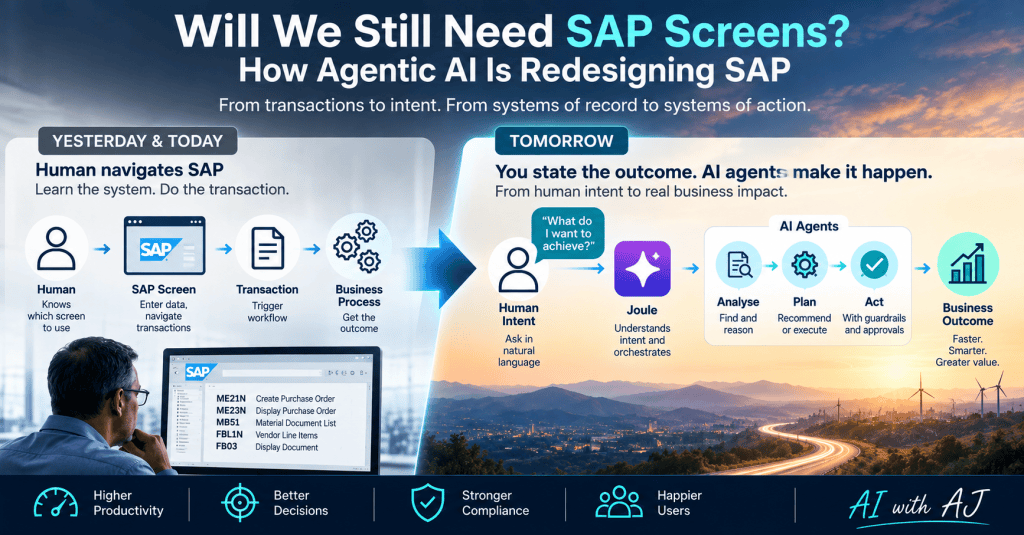
Having worked with SAP for more than two decades, I have watched generations of enterprise users learn transaction codes, screens, workflows and, more recently, Fiori applications.
We learned how SAP works.
We learned which transaction to open, which fields to populate, which workflow to trigger and where to look when something went wrong.
But Agentic AI raises an interesting question that I would not have seriously asked a few years ago:
Will we still need SAP screens?
My answer is: yes — but perhaps not in the way we use them today.
The bigger transformation may not be another redesign of the SAP user interface.
It may be a change in the relationship between people and ERP itself.
From Transactions to Intent
Think about how enterprise software has traditionally worked.
Human → Screen → Transaction → Workflow → Business Outcome
The user needs to understand the application before the application can deliver the outcome.
Generative AI has already started changing this.
With Joule and other copilots, users can increasingly interact with enterprise information using natural language.
But Agentic AI takes this one step further.
Imagine:
Human Intent → Joule → AI Agents → SAP Processes + Data → Governed Action → Business Outcome
That is fundamentally different.
Instead of asking:
“Which SAP transaction should I use?”
we may increasingly say:
“Tell SAP what outcome you want.”
Consider a Simple Procurement Example
Imagine I am a procurement manager.
Today, I might open SAP, search for purchase orders, check delivery status, look at goods receipts, investigate supplier information and perhaps contact the buyer.
Now imagine asking:
“Which critical purchase orders are likely to delay production next week, and what should we do about them?”
This is not simply a search request.
An AI agent could potentially analyse open purchase orders, delivery dates, inventory positions, supplier performance, production requirements and historical delays.
It could identify the highest-risk orders.
But an agentic system could go further.
It could recommend an alternative supplier, prepare an expedite request, draft communication to the supplier, initiate the appropriate workflow and ask the buyer for approval before taking a sensitive action.
Suddenly, the user is no longer navigating SAP transaction by transaction.
The user is managing the business outcome.
SAP Is Already Moving in This Direction
This is why recent developments around SAP Business AI are interesting.
SAP is positioning Joule increasingly as an orchestration layer for enterprise work, supported by specialised assistants and AI agents.
At the same time, SAP is bringing together capabilities across Business Data Cloud, Knowledge Graph, Signavio, LeanIX, WalkMe and Cloud ALM.
Look at what these components collectively represent:
Joule provides the conversational entry point.
AI assistants and agents understand intent, reason and perform specialised tasks.
Business Data Cloud and business context provide governed enterprise information.
Signavio understands business processes.
LeanIX provides enterprise architecture context.
WalkMe can help bridge interaction with applications.
Cloud ALM and emerging agent-management capabilities provide another part of the operational and governance layer.
Individually, these are useful technologies.
Together, however, they point toward something much bigger:
an intelligent execution layer sitting above enterprise applications and processes.
From System of Record to System of Action
For decades, we have described SAP as a System of Record.
And that will remain extremely important.
Purchase orders still need to exist.
Invoices still need to be posted.
Assets still need to be maintained.
Financial controls still need to operate.
Auditability still matters.
But Agentic AI introduces another layer.
The enterprise system doesn’t just record what happened.
Increasingly, AI can understand what needs to happen next.
That is why I believe we may be seeing the emergence of:
SAP as a System of Record + System of Intelligence + System of Action
This distinction matters.
A traditional ERP stores and processes transactions.
An intelligent ERP helps us understand those transactions.
An agentic ERP can potentially reason across them and orchestrate the next action — within clearly defined business controls.
Imagine Month-End Close
Consider another familiar SAP process.
A finance manager asks:
“What is stopping us from closing this period?”
Traditionally, teams investigate exceptions across multiple reports, transactions, emails and spreadsheets.
Now imagine an AI assistant identifying unresolved GR/IR items.
Specialised agents investigate the underlying purchase order, goods receipt and invoice.
They identify likely causes, prioritise material exceptions and recommend corrective action.
For straightforward cases, the system prepares the next step.
For sensitive cases, it asks the responsible person for approval.
The finance manager isn’t necessarily interested in which five SAP screens were required.
They are interested in:
Why can’t we close?
What needs attention?
What can AI resolve?
What requires my decision?
That is a very different user experience.
Does This Mean SAP Screens Will Disappear?
No.
And I don’t think that should be the objective.
Complex configuration, exception handling, detailed analysis, controls and specialist activities will continue to require rich application interfaces.
But I believe something subtler will happen.
The screen may stop being the primary interface for every SAP interaction.
Routine work can increasingly become conversational and agent-driven.
Specialist work remains application-driven.
High-risk decisions remain human-controlled.
This creates a hybrid enterprise where humans, agents, APIs, workflows and traditional applications operate together.
The Real Challenge Is Not the LLM
There is also an important reality behind all this excitement.
Giving an AI agent permission to read a purchase order is relatively easy.
Allowing it to change one is very different.
Once agents start acting inside enterprise systems, organisations need to think seriously about identity, authorisation, segregation of duties, approvals, audit trails, observability and accountability.
Who authorised the agent?
Which transactions can it execute?
What happens when it is uncertain?
Which actions require human approval?
Can we reconstruct why a decision was made?
And can we stop or reverse an incorrect action?
This is where Agentic AI becomes an enterprise architecture and operating-model discussion — not simply an LLM discussion.
A New Chapter for ERP
For years, enterprise transformation focused on making ERP easier for humans to use.
Better screens.
Better workflows.
Mobile applications.
Fiori.
Automation.
Copilots.
Agentic AI introduces another possibility.
Perhaps the next generation of ERP will increasingly understand what we are trying to achieve and orchestrate the underlying systems on our behalf.
So, will we still need SAP screens?
Absolutely.
But perhaps fewer people will need to know which screen, transaction or workflow sits behind every business outcome.
And that could represent one of the most significant changes to enterprise software since ERP itself.
For decades, we taught people how to operate SAP.
The next chapter may be about teaching SAP how to understand our intent — and safely act upon it.
— AI with AJ


Leave a comment