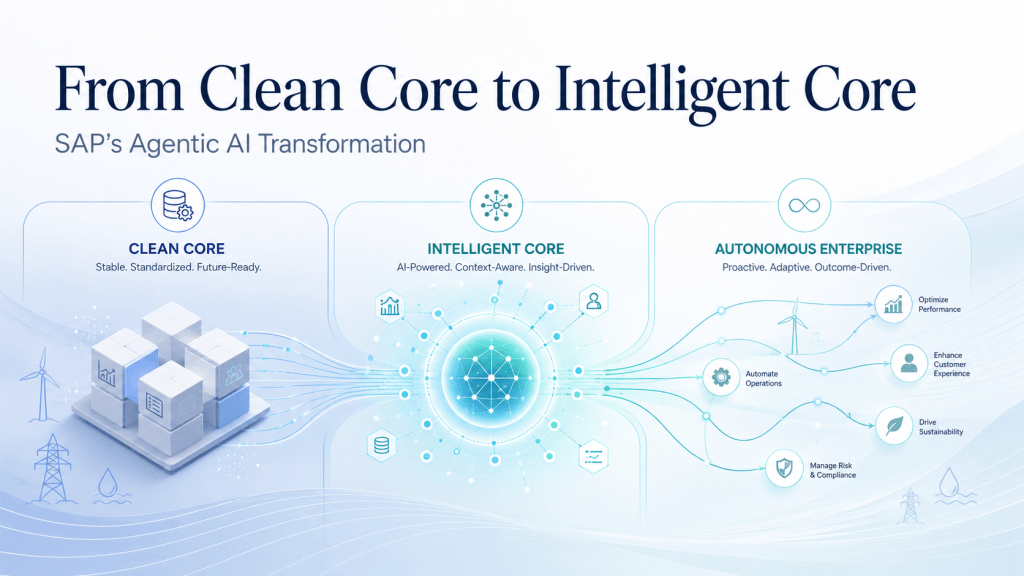
How SAP AI Core, AI Launchpad, Joule and trusted business data are transforming ERP from a system of record into a system of reasoning and action
For more than two decades, SAP transformation programmes have focused on one major objective: cleaning the core.
Organisations have been removing unnecessary customisations, standardising business processes, reducing technical debt and moving extensions from the ERP system to SAP Business Technology Platform.
The purpose is clear. A Clean Core makes SAP easier to maintain, upgrade and continuously improve.
But cleaning the core was never the final destination.
It was preparation for something much more significant: an SAP environment that does not simply record business transactions, but understands business context, identifies emerging problems, recommends decisions and coordinates the actions required to resolve them.
SAP is now moving from the Clean Core to what I describe as the Intelligent Core—and agentic AI is the bridge between the two.
Clean Core makes SAP easier to change.
Intelligent Core enables SAP to understand, reason and act.
Clean Core solved yesterday’s SAP problem
Traditional SAP environments accumulated thousands of custom developments over many years.
Whenever the business required something new, another report, interface, workflow, user exit or custom transaction was created. Eventually, companies ended up with complex ERP landscapes that were difficult and expensive to upgrade.
Clean Core addresses this problem by keeping the essential SAP transactional system standardised and stable. Differentiating capabilities can be developed as side-by-side extensions on SAP BTP instead of being embedded deeply inside SAP S/4HANA.
However, a technically clean ERP system is not automatically an intelligent enterprise.
It may process a maintenance order perfectly—but it may not recognise that repeated failures across several substations indicate a wider asset risk.
It may produce thousands of customer bills accurately—but it may not understand why customers repeatedly contact the utility about estimated meter readings.
This is where the Intelligent Core begins.
What is the Intelligent Core?
I use the term Intelligent Core to describe the combination of trusted SAP transactions, governed business data, AI models, business semantics and autonomous agents.
It is not a single SAP product.
Several components work together:
- SAP S/4HANA executes controlled business transactions.
- SAP Business Data Cloud provides governed enterprise data.
- SAP AI Core manages the execution and operation of AI assets.
- The generative AI hub provides governed access to generative AI models.
- SAP AI Launchpad helps teams manage AI scenarios, deployments, prompts and model lifecycles.
- Joule provides the conversational employee experience.
- Joule Studio supports the development and management of agents, applications and workflows.
- SAP AI Agent Hub provides visibility and governance across the enterprise agent landscape.
SAP introduced its unified SAP Business AI Platform in May 2026, bringing SAP BTP, SAP Business Data Cloud and SAP Business AI together within one governed environment. SAP is positioning this as the foundation for its vision of the Autonomous Enterprise.
SAP AI Core is the engine; AI Launchpad is the cockpit
SAP AI Core and SAP AI Launchpad are sometimes discussed as though they perform the same role. Their responsibilities are different but complementary.
SAP AI Core is the runtime engine. It manages the execution and operation of AI workloads, models and related assets on SAP BTP. The generative AI hub within AI Core gives developers governed access to different foundation models without requiring every application to connect independently to a model provider.
SAP AI Launchpad is the operational cockpit. It allows AI engineers, administrators and business users to manage AI use cases, access generative AI hub capabilities, experiment with prompts, deploy models and monitor their lifecycle.
Consider a simple energy demand-forecasting example.
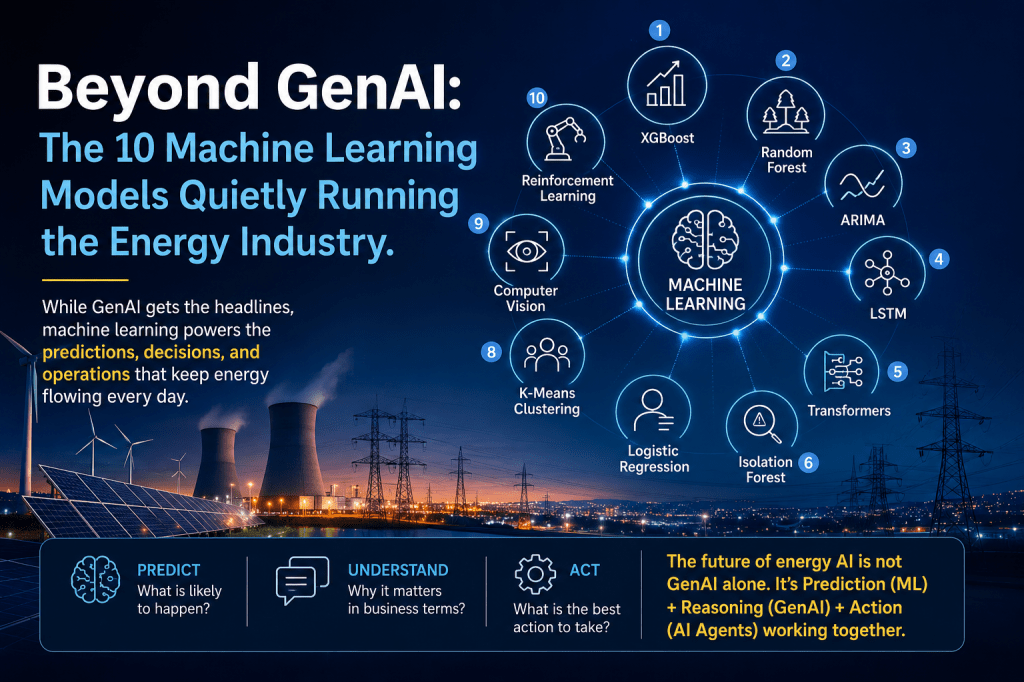
A utility develops a machine-learning model to predict electricity demand for the following day. SAP AI Core can run the model and produce predictions. SAP AI Launchpad allows the AI team to manage the deployment and monitor its operation.
The prediction can then be presented through Joule or incorporated into an SAP planning process.
From embedded AI to agentic AI
The first generation of enterprise AI mainly provided predictions or recommendations inside individual applications.
Agentic AI goes further.
An AI agent can understand a goal, determine the steps required, access authorised tools and data, collaborate with other agents and take controlled action.
Imagine that a wind-turbine monitoring system detects abnormal vibration.
A traditional alerting system might send an alarm to an engineer.
An intelligent SAP agent could:
- Identify the affected turbine and component.
- Review similar historical incidents.
- Check the maintenance history.
- assess the operational and safety risk.
- Verify whether the required spare part is available.
- Recommend the appropriate maintenance action.
- Prepare a work order for human approval.
- Schedule the engineer after approval.
At SAP Sapphire 2026, SAP highlighted work with RWE involving autonomous asset management for offshore wind turbines. The announced scenario uses AI agents to analyse previous incidents, identify likely root causes and prepare work orders containing recommended tools and proven corrective actions.
This is the difference between an AI that says “something may be wrong” and an agentic system that helps organise the response.
Deterministic SAP meets probabilistic AI
This is perhaps the most important design principle behind the Intelligent Core.
SAP transactions are deterministic. Business rules, configurations and controls determine how an approved transaction is executed.
Generative AI is probabilistic. It interprets context, evaluates possibilities and proposes the most appropriate response.
These capabilities should not be confused.
AI reasons about what should happen.
SAP controls how the approved transaction happens.
Consider an electricity-network procurement example.
An AI agent may identify that an important transformer component is likely to arrive late. It could analyse inventory, supplier history, planned maintenance and alternative sources before recommending that the buyer move the order to another approved supplier.
But the agent should not bypass procurement controls.
Supplier eligibility, spending limits, segregation of duties, approval workflows and purchase-order creation should remain governed by SAP.
The Intelligent Core therefore combines the flexibility of AI reasoning with the reliability of controlled ERP execution.
Joule becomes the front door to SAP
In the traditional SAP world, employees must know which application, transaction or report to open.
In the agentic world, the employee can begin with the desired outcome.
A utility maintenance manager might ask Joule:
“Which substations are at greatest risk of equipment failure during next week’s heatwave, and what preventive work should we prioritise?”
Behind that question, different capabilities could work together:
- Asset data provides equipment history.
- Weather information provides an external risk signal.
- An AI model estimates the probability of failure.
- A maintenance agent identifies recommended work.
- An inventory agent checks spare-part availability.
- A workforce agent checks engineer capacity.
- SAP workflow sends the proposed plan for approval.
- SAP S/4HANA creates the approved maintenance orders.
Joule is the visible interface, but the real value comes from the combination of business data, AI Core, agents, workflow and controlled execution.
SAP describes Joule Assistants as role-oriented collaborators, while Joule Agents perform specialised tasks and execute workflows. SAP has announced more than 50 domain-specific assistants intended to orchestrate more than 200 specialised agents across areas including finance, procurement, supply chain, HR and customer experience. These figures represent SAP’s announced product direction and rollout, rather than capabilities already deployed at every customer.
A simple water-utility example
Consider a customer reporting unusually high water consumption.
Instead of transferring the customer between billing, metering and leakage teams, an agentic process could:
- Retrieve the customer’s recent meter readings.
- Compare consumption with the customer’s historical pattern.
- Check for known meter problems.
- Identify possible internal or network leakage.
- Explain the likely reason in simple language.
- Offer an appointment or create a service request.
- Escalate the case when human judgement is required.
The customer experiences one joined-up conversation, even though several systems and business teams may be involved.
SAP has highlighted customer self-service, predictive asset management and distributed-energy-resource management as important AI opportunities for utilities. It also stresses that scaling these use cases requires integrated data, lifecycle management, security, compliance and governance—not simply a successful proof of concept.
Agent governance is the new Clean Core challenge
SAP customers spent years trying to control the proliferation of custom code.
They may soon face a new challenge: agent proliferation.
Different departments may develop agents using SAP, Microsoft, Google, AWS, ServiceNow, n8n or open-source frameworks.
Without governance, organisations could create:
- Duplicate agents solving the same problem
- Conflicting business rules
- Uncontrolled access to SAP transactions
- Inconsistent security and approval controls
- Unclear accountability for agent decisions
- Unmanaged model and infrastructure costs
- Limited monitoring and auditability
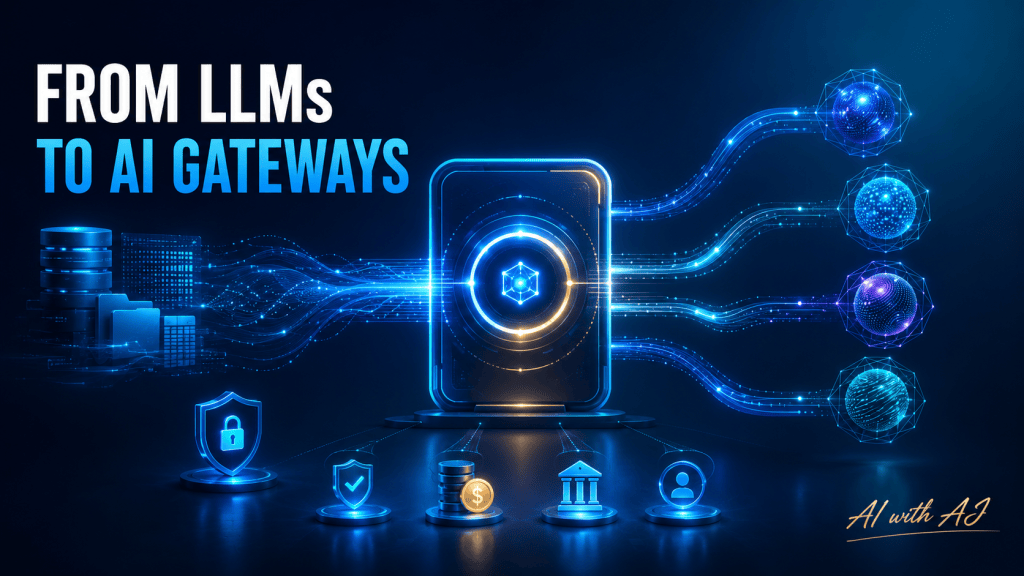
SAP AI Agent Hub is intended to provide a central place to discover, inventory, govern and evaluate agents, models and MCP servers across an enterprise landscape. SAP Cloud ALM is also being positioned to support operational observability for agents, including session tracing and goal-completion monitoring.
The next generation of SAP governance must therefore address two complementary objectives:
Clean Core for application governance.
Governed Agent Core for AI governance.
The road ahead for energy and utilities
Energy and utility companies operate some of society’s most critical infrastructure.
An incorrect recommendation affecting a retail campaign is inconvenient. An incorrect autonomous action affecting a gas network, electricity grid or water-treatment facility could be serious.
The objective should not be uncontrolled autonomy.
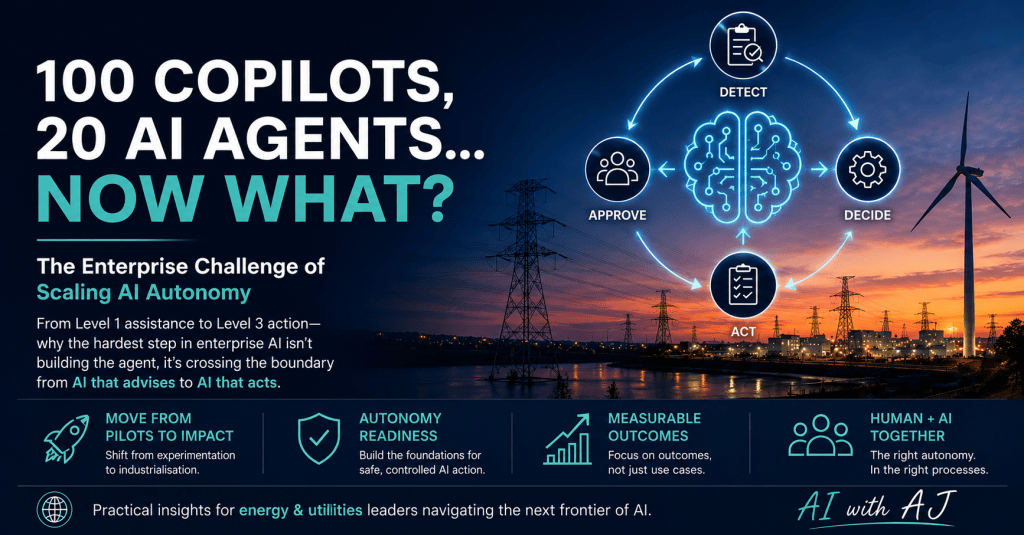
The objective should be graduated autonomy:
- Low-risk tasks can be automated.
- Medium-risk actions require approval.
- High-risk operational decisions remain human-led.
- Every agent action must be observable and auditable.
The future of SAP will not be defined only by how many AI features are embedded in individual applications.
It will be defined by whether SAP can successfully combine trusted business data, domain knowledge, deterministic transactions and probabilistic AI reasoning within one governed operating model.
Clean Core made SAP ready for continuous innovation.
Intelligent Core could make SAP ready for intelligent and increasingly autonomous operations.
And for energy and utility companies, this transformation may determine how effectively they maintain ageing infrastructure, integrate renewable energy, support vulnerable customers and manage the increasingly complex energy transition.
AI-with-AJ perspective: The winners will not be the organisations that build the largest number of agents. They will be those that connect a smaller number of well-designed agents to trusted data, controlled processes and measurable business outcomes.
 THE AI CHRONICLE
Leave a comment