For years, we have talked about how artificial intelligence will transform industries.
Healthcare.
Finance.
Manufacturing.
Energy.
But something unexpected is happening.
AI is not just transforming the energy sector.
It is becoming one of its fastest-growing consumers.
And at the same time, the energy industry is increasingly relying on AI to manage the complexity of modern power systems.
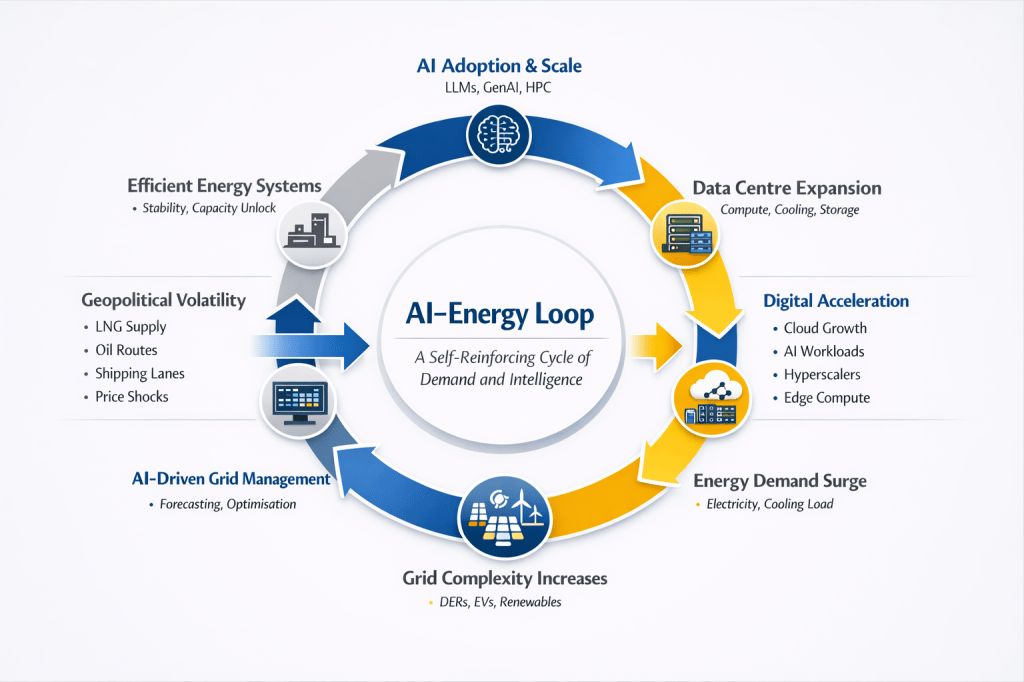
This creates a powerful feedback cycle — what I call the AI–Energy Loop.
Two industries that once evolved independently are now becoming deeply interdependent.
AI Is Becoming a Major Consumer of Electricity
Artificial intelligence runs on computation.
Large language models, machine learning training clusters, and real-time AI inference require enormous amounts of computing power.
Behind that computing power are data centres — thousands of servers operating continuously.
These facilities consume vast amounts of electricity for:
- compute infrastructure
- cooling systems
- storage systems
- networking equipment
As AI adoption accelerates across industries, the demand for high-performance computing is rising sharply.
Many energy analysts now expect AI-driven data centres to become one of the largest sources of electricity demand growth in the coming decade.
This is a structural shift.
For utilities, the technology sector is no longer just another customer segment.
It is becoming a strategic energy partner.
Energy Systems Are Becoming Too Complex for Humans Alone
At the same time that AI is consuming more energy, the energy system itself is becoming dramatically more complex.
Consider what modern grids must handle:
- renewable generation variability
- distributed energy resources
- electric vehicle charging demand
- heat pump electrification
- dynamic energy markets
- climate-driven weather volatility
Traditional grid operations were designed for predictable generation from centralized power plants.
But today’s system includes millions of decentralized energy assets.
Managing this complexity requires processing vast amounts of operational data:
- SCADA telemetry
- weather forecasts
- market signals
- asset performance data
- demand patterns
This is where AI becomes essential.
Utilities are increasingly using AI to:
- forecast electricity demand
- optimise generation scheduling
- detect asset failures
- predict outages
- manage grid stability
In other words, AI is becoming the operational brain of modern energy systems.
A System Under Stress: Geopolitics Meets Energy Demand
In recent months, geopolitical tensions in the Middle East have once again reminded us how fragile global energy systems can be.
Supply disruptions, price volatility, and uncertainty around critical energy corridors have immediate ripple effects across markets.
For utilities, this is not a distant geopolitical issue.
It directly impacts:
- energy availability
- price stability
- planning assumptions
- investment decisions
At the same time, the rise of AI is increasing electricity demand at an unprecedented pace.
These two forces — geopolitical instability and digital demand growth — are now colliding.
And the impact goes beyond electricity.
Global energy flows are deeply dependent on:
- LNG shipments
- oil transportation routes
- maritime chokepoints and shipping lanes
Any disruption in these corridors can influence fuel availability, generation costs, and ultimately electricity pricing.
This makes one thing clear:
Energy systems are no longer just infrastructure.
They are becoming strategic assets in a volatile world.
And managing this volatility will require far more intelligence than traditional systems can provide.
A Circular Dependency Is Emerging
This is where things get interesting.
AI needs energy.
Energy systems need AI.
Each industry is becoming dependent on the other.
The loop looks something like this:
- AI adoption increases computing demand
- Data centres consume more electricity
- Energy systems must expand capacity and improve efficiency
- Utilities use AI to manage increasingly complex grids
- Improved energy systems enable more AI infrastructure
And the cycle continues.
This AI–Energy Loop will shape both industries for the next decade.
The Rise of AI-Powered Energy Infrastructure
Many utilities are already beginning to plan for this shift.
Large hyperscale data centres now require:
- dedicated transmission infrastructure
- grid connection studies
- long-term power purchase agreements
- renewable energy sourcing
Some utilities are even designing energy clusters specifically for AI infrastructure.
At the same time, technology companies are investing directly in energy generation, including:
- renewable power projects
- battery storage
- advanced cooling technologies
- energy optimisation platforms
The boundaries between the technology sector and the energy sector are starting to blur.
Data Centres May Become Grid Assets
Another fascinating possibility is emerging.
Traditionally, data centres are treated purely as electricity consumers.
But what if they could also act as flexible grid resources?
AI workloads do not always need to run at a specific time.
Some training workloads could shift depending on:
- electricity prices
- grid congestion
- renewable generation availability
If managed intelligently, data centres could participate in demand response programs, helping balance the grid during periods of stress.
In this scenario, AI infrastructure becomes not just a load on the grid — but part of its solution.
Strategic Implications for Utilities
For energy companies, the AI–Energy Loop creates several strategic opportunities.
1. New Demand Growth
AI infrastructure could drive significant electricity demand growth after years of relatively flat consumption.
2. New Types of Energy Customers
Hyperscale operators require high reliability, capacity, and renewable sourcing.
3. Smarter Grid Operations
AI-driven intelligence becomes essential to manage volatility and complexity.
4. Resilience in a Volatile World
Utilities must now plan for both digital demand growth and geopolitical uncertainty simultaneously.
The Leadership Question
For energy executives, an important strategic question emerges:
Are we prepared for a world where both AI growth and geopolitical dynamics directly shape the evolution of the power grid?
Planning for future electricity demand will no longer depend only on population growth or industrial expansion.
It will increasingly depend on:
- the scale of AI infrastructure
- the stability of global energy supply chains
A Final Thought
For most of modern history, technology companies depended on electricity.
But electricity systems did not depend on technology companies.
That relationship is changing.
Artificial intelligence is becoming both:
- a major consumer of electricity
- a critical tool for managing energy systems
And in a world shaped by both digital acceleration and geopolitical uncertainty, this interdependence becomes even more critical.
The future will not belong to AI alone. And it will not belong to energy alone.
It will belong to the AI–Energy Loop — where intelligence and infrastructure evolve together.
 THE AI CHRONICLE
Leave a comment