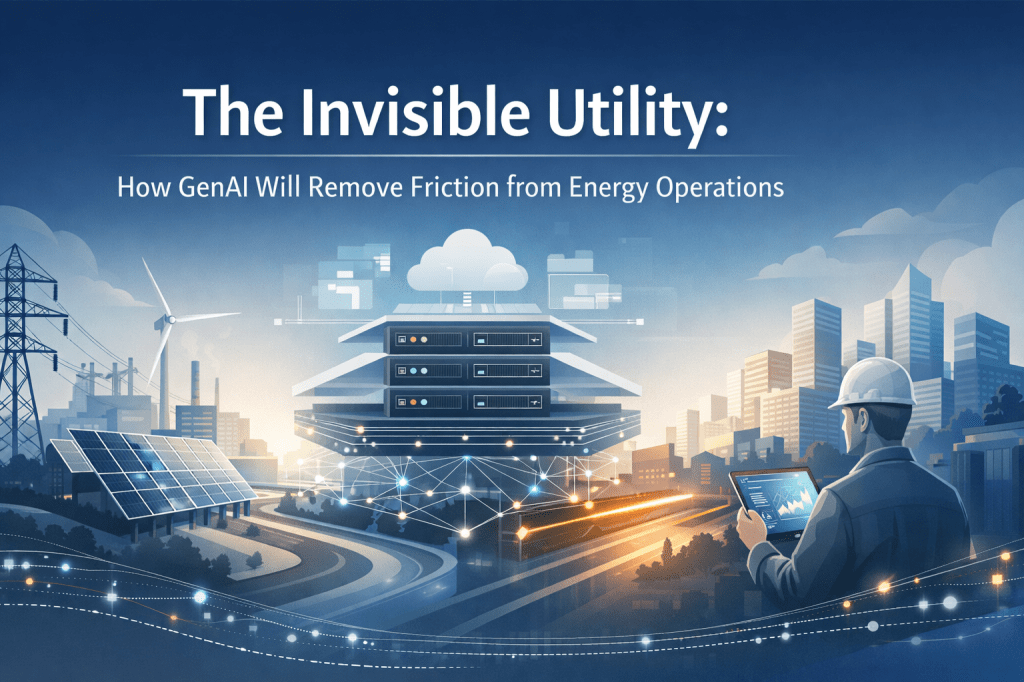
For decades, utilities have focused on reliability. Lights must stay on.
Gas must flow. Water must reach homes.
And to achieve that reliability, we built layers of processes, controls, approvals, documentation, audits, and oversight.
Over time, something else was built alongside infrastructure.
Friction.
Not visible friction. Not dramatic failure.
But quiet, operational resistance in almost every workflow.
As we enter 2026, I believe Generative AI will not transform utilities by replacing engineers or automating everything.
It will transform utilities by doing something much simpler — and much more powerful:
It will remove friction from energy operations.
And when that friction disappears, utilities themselves will start to feel… invisible.
Utilities Don’t Lack Intelligence. They Carry Too Much Complexity.
Every utility I work with is full of intelligent people. Engineers who understand network constraints deeply. Operations teams who know asset behaviour intuitively. Regulatory experts who can interpret complex compliance language.
The problem has never been lack of expertise.
The problem is that expertise is buried inside:
- Disconnected systems
- Email trails
- PDF documents
- Spreadsheets
- Regulatory updates
- Approval chains
- Knowledge silos
In most utilities today, complexity is managed manually. And manual complexity creates friction.
What Does “Operational Friction” Actually Look Like?
Let’s make this concrete.
Friction shows up in five recurring areas.
1️⃣ Planning Friction
Transmission and distribution planning cycles often take months.
Why?
- Data sits in different systems
- Scenario modelling is manual
- Engineering knowledge is dispersed
- Documentation must be compiled repeatedly
The design itself may not be the bottleneck.
The orchestration of information is.
2️⃣ Regulatory Friction
Utilities operate under intense scrutiny — especially in the UK under Ofgem and Net Zero mandates.
Regulatory friction appears when:
- New policies must be interpreted manually
- Obligations are mapped to internal controls by hand
- Evidence packs are assembled during audit season
- ESG reports require weeks of consolidation
Compliance is not optional.
But compliance overhead is enormous.
3️⃣ Field Operations Friction
Field engineers often face:
- Incomplete asset history
- Disconnected work order systems
- Delayed approvals
- Limited contextual insight
They spend time navigating systems instead of solving problems.
The grid does not slow them down.
Process does.
4️⃣ Customer Operations Friction
Retail utilities deal with:
- Billing disputes
- Vulnerable customer identification
- Tariff complexity
- Complaint resolution cycles
Much of this is driven by unstructured data — calls, emails, notes.
Humans manually interpret context repeatedly.
5️⃣ IT & AMS Friction
Application landscapes in utilities are heavy:
- SAP
- Salesforce
- ServiceNow
- Legacy billing systems
- Asset management platforms
Incident triage, root cause analysis, cross-system dependency mapping — all require human stitching together of context.
Again, not an intelligence gap.
A context gap.
Where Generative AI Changes the Equation
Generative AI introduces something utilities have never had at scale:
- Context synthesis across systems
- Unstructured data interpretation
- Real-time summarisation
- Automated documentation
- Cross-domain reasoning
Instead of asking humans to navigate complexity, GenAI can now navigate complexity for them.
Not by replacing decision-making.
But by preparing, organising, and contextualising it.
Think of GenAI as:
An operational lubricant.
In a mechanical engine, performance loss often comes from friction.
Add lubrication — and the engine runs smoother, quieter, more efficiently.
The same principle applies here.
The Invisible Utility in Practice
When friction reduces, something interesting happens.
The utility becomes “invisible” — not to customers, but internally.
Let me describe what that looks like.
- Regulatory reports draft themselves continuously instead of being assembled reactively.
- Engineering design options are generated in hours, not weeks.
- Asset risk summaries update dynamically based on telemetry and maintenance logs.
- Vulnerable customers are flagged proactively from behavioural signals.
- Compliance obligations map automatically to operational controls.
- Incident tickets arrive with probable root cause attached.
No one is “using AI” consciously.
They are simply experiencing less resistance.
The organisation feels lighter.
This Is Not an AI Story. It Is an Operating Model Story.
The real shift is not technological.
It is architectural.
Utilities that benefit from GenAI in 2026 will not be those with the most pilots.
They will be those who:
- Embed intelligence into workflows
- Redesign approval cycles
- Rethink documentation processes
- Treat context as infrastructure
- Govern AI as an operational capability
This requires maturity.
GenAI must move from experiment to embedded layer.
From tool to infrastructure.
Why This Matters More Than Model Accuracy
We are entering a phase where model performance differences are narrowing.
Switching between models is easier than before.
Having AI access is no longer a differentiator.
The advantage shifts elsewhere.
It shifts to:
- How deeply AI is integrated into processes
- How cleanly data flows across systems
- How clearly decision rights are defined
- How well AI outputs are audited and governed
In other words:
Architecture now matters more than algorithms.
The Strategic Impact
When friction reduces across the organisation, several things happen simultaneously:
- Cost-to-serve drops
- Cycle times compress
- Regulatory risk reduces
- Operational resilience increases
- Customer trust improves
Not because AI is flashy.
But because operations are smoother.
In a margin-sensitive industry like utilities, friction removal is not cosmetic.
It is strategic.
The Leadership Question for 2026
If GenAI removes friction, leadership priorities must shift.
Boards and CxOs should now ask:
- Where does friction cost us the most today?
- Which processes are heavy because of documentation overhead?
- Where are engineers spending time navigating systems instead of solving problems?
- What decisions are delayed because context is fragmented?
- Where should intelligence be embedded — and where should it remain human-led?
The conversation moves from:
“Where can we use AI?”
To:
“Where is friction slowing us down?”
That is a more powerful starting point.
Why Many Utilities May Miss This
There is a risk in 2026.
Utilities may:
- Deploy chatbots
- Run pilots
- Experiment with copilots
- Automate isolated tasks
But fail to remove systemic friction.
Because friction removal requires:
- Process redesign
- Architecture thinking
- Cross-functional collaboration
- Governance maturity
It is harder than deploying a model.
But it creates lasting advantage.
A Final Thought
Utilities have spent decades mastering physical infrastructure.
Generation assets.
Transmission networks.
Substations.
Pipelines.
Now they must master something new:
Intelligence infrastructure.
Not visible dashboards.
Not shiny demos.
But embedded, invisible intelligence that absorbs complexity and reduces resistance.
In the coming decade, the most successful utilities will not be the ones that talk most about AI.
They will be the ones that feel the least friction.
And when operations feel seamless, almost effortless —
That is when you know the utility has become invisible.
 THE AI CHRONICLE
Leave a comment