Utilities today are not short of technology. They are not short of data.
And they are certainly not short of AI pilots.
Yet whether in industry reviews or leadership conversations, the same frustration keeps emerging:
“We have smart meters, analytics platforms, and AI tools — but decision-making is still slow.”
This is not a failure of ambition. It is not even a failure of AI.
It is a design challenge.
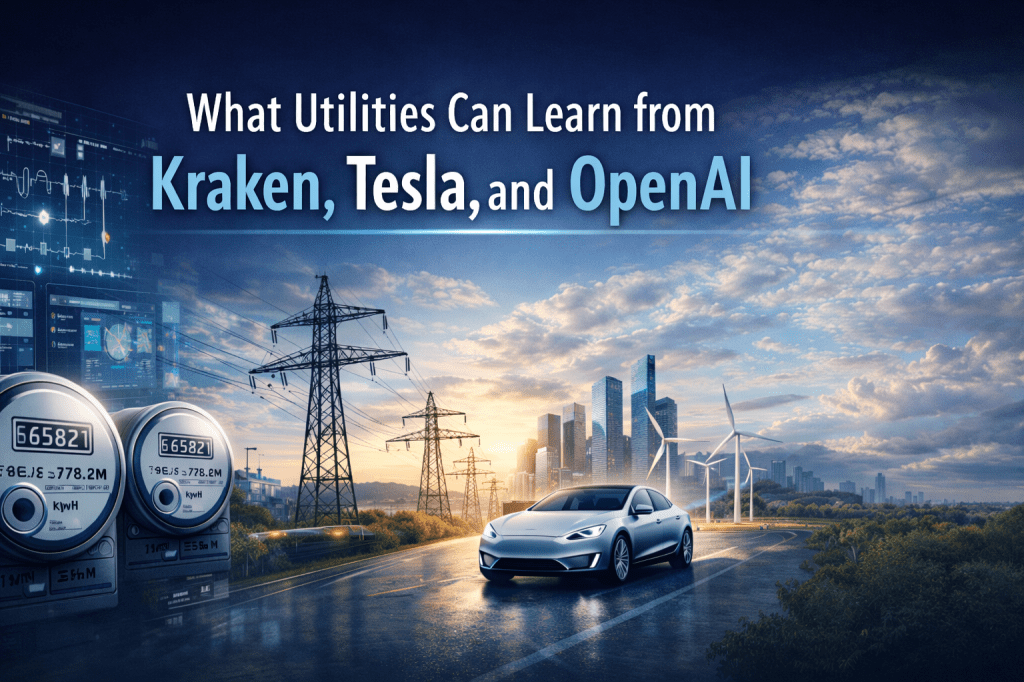
To understand why, it helps to look beyond the utilities sector — at three very different organisations: Kraken, Tesla, and OpenAI.
Each operates in a complex, regulated, data-intensive environment.
And each has quietly redefined how intelligence is embedded into operations.
Kraken: Customer Operations Are a System, Not a Department
Kraken is often described as a billing or customer platform.
That description undersells its significance.
Kraken treats customer operations as a real-time system:
- Events flow continuously
- Exceptions surface instantly
- Humans intervene only where judgment is required
AI does not “assist” customer service teams in isolation.
It orchestrates work across metering, billing, networks, and field services.
For utilities, the lesson is simple but profound:
Customer experience is no longer a contact-centre problem.
It is a systems architecture problem.
When AI coordinates the flow of work rather than responding to tickets, resolution times shrink, trust improves, and complexity becomes manageable.
Tesla: Control Loops Matter More Than Dashboards
Utilities are exceptionally good at monitoring.
Dashboards, SCADA views, outage maps — we can see almost everything.
Tesla focuses on something different: control loops.
Every Tesla vehicle is continuously:
- Sensing its environment
- Making decisions
- Acting
- Learning from outcomes
The intelligence is not in the user interface.
It is embedded in the feedback loop between data, decision, and action.
For grid operators and asset managers, this is a critical shift:
The future grid is not just monitored.
It is self-correcting.
Prediction without action is simply analytics.
Real value emerges when AI closes the loop — turning insight into automated response, safely and repeatedly.
OpenAI: Intelligence Is a Platform Capability
OpenAI is often viewed as a model company. In reality, it is something more strategic.
OpenAI provides intelligence as a platform:
- Reasoning
- Memory
- Tool execution
- Guardrails
- Evaluation
Thousands of use cases sit on top of these capabilities — most of which OpenAI never explicitly designed.
Utilities can learn a powerful lesson here:
Stop building isolated AI use cases.
Start building reusable AI capabilities.
When reasoning, retrieval, workflow execution, and governance are embedded once, innovation scales naturally across operations, customer service, compliance, and planning.
The Common Thread: AI as Infrastructure
Kraken, Tesla, and OpenAI succeed for one common reason.
They do not treat AI as a project or an experiment.
They treat it as infrastructure:
- Always on
- Deeply embedded
- Invisible to users
- Trusted enough to act
Utilities already understand infrastructure better than most industries. Reliability, resilience, and safety are part of their DNA.
The opportunity now is to apply the same thinking to intelligence itself.
What This Means for Utilities in 2026
The next generation utility will not be defined by the number of AI pilots it runs.
It will be defined by:
- Event-driven operations instead of batch processes
- Closed-loop decisioning instead of static reporting
- AI agents working alongside humans, not replacing them
- Platforms that compound value, not projects that expire
Utilities do not need to become technology companies.
But they do need to become designers of intelligent systems.
Final Thought
The question facing utility boards today is no longer:
“Should we invest in AI?”
It is:
“Will AI sit on the surface of our organisation — or will it run beneath it?”
The answer will determine who leads the next decade of utilities transformation
 THE AI CHRONICLE
Leave a comment