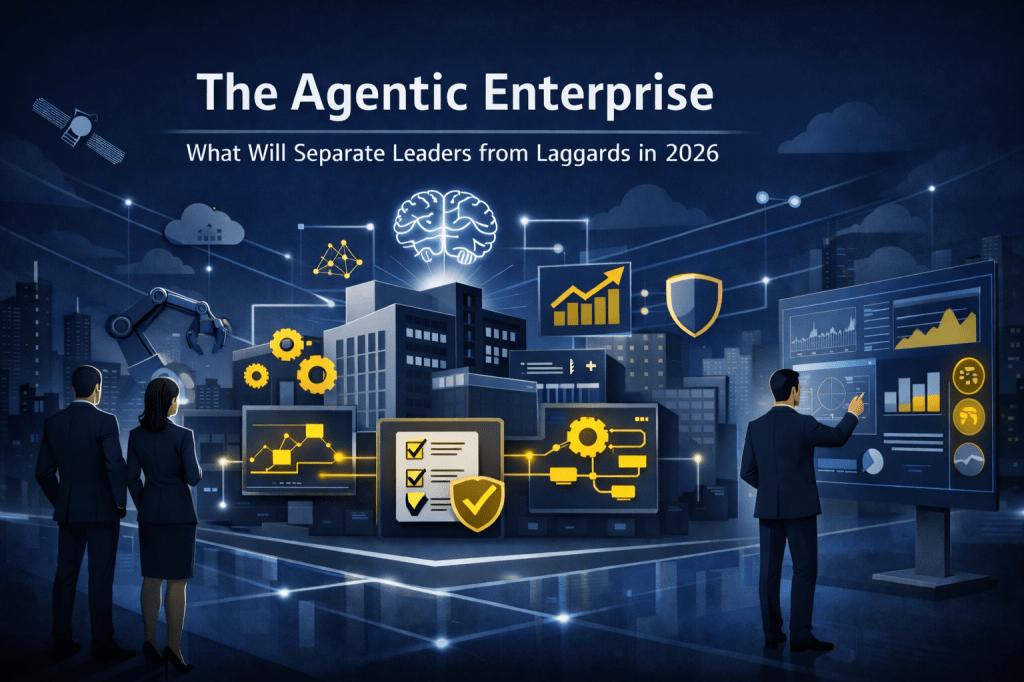
Most of the enterprises we hear from today say the same thing:
“We are already using GenAI.”
And they’re right.
Chatbots answer questions. Copilots help write emails. Models summarise documents. But here’s the uncomfortable truth:
By 2026, GenAI usage will no longer be a differentiator.
What will separate leaders from laggards is something far deeper — agentic capability.
This is the moment where enterprises must decide:
Will AI remain a tool we consult…
or become a system we delegate outcomes to?
From Using AI to Becoming Agentic
Let’s start with a simple distinction.
Most organisations today are AI-enabled. Very few are agentic.
An agentic enterprise is not built around prompts, copilots, or clever demos. It is built around goal-driven AI systems that can:
- Sense what is happening
- Understand context and constraints
- Decide on next best actions
- Execute across systems
- Learn from outcomes
In other words:
An agentic enterprise doesn’t ask AI for answers.
It assigns AI responsibility.
This shift — from interaction to delegation — is the defining transformation of the next two years.
Why 2026 Is the Tipping Point
2024 was the year of experimentation.
2025 is the year of pilots and scaling attempts.
2026 is when the consequences show up.
By then:
- Every major enterprise will have access to similar models
- Model performance gaps will narrow
- “AI strategy” slides will look suspiciously identical
Yet outcomes will diverge dramatically.
Some organisations will operate faster, safer, and smarter — almost invisibly. Others will still be stuck in AI theatre.
The difference will not be the model.
It will be how AI is embedded into the operating fabric of the enterprise.
The Five Separators: Leaders vs Laggards in 2026
1. Goal-Driven Systems vs Prompt-Driven Usage
Leaders design AI around objectives:
- Reduce outages
- Improve cash flow
- Accelerate approvals
- Lower operational risk
AI agents are given goals, guardrails, and authority to act.
Laggards still rely on:
- Ad-hoc prompts
- Human-in-the-loop for every decision
- Chat interfaces disconnected from execution
Prompts scale curiosity.
Goals scale outcomes.
2. AI Embedded in Workflows vs AI Sitting on the Side
In leading enterprises, AI agents are woven directly into:
- Asset management workflows
- Procurement and P2P funnels
- Compliance and risk processes
- Customer operations
The AI doesn’t wait to be asked — it intervenes when needed.
In lagging organisations, AI lives:
- In a separate chat window
- Outside core systems
- Without real authority
If AI cannot act where work happens, it will never change how work happens.
3. Context, Memory, and Process vs Model Obsession
Leaders in 2026 will talk less about:
- Which model they use
- Token limits
- Parameter counts
And far more about:
- Context engineering
- Organisational memory
- Process intelligence
- Decision traceability
They understand a simple truth:
A powerful model without context behaves like a smart intern on day one — every day.
Laggards will continue swapping models, hoping performance magically improves.
4. Human-AI Teaming vs Human-AI Dependency
Agentic leaders design teaming models:
- AI proposes
- Humans supervise and steer
- AI executes at scale
Decision rights are explicit. Accountability is clear.
Laggards either:
- Over-automate blindly
- Or mistrust AI so much that nothing moves without human approval
Both extremes fail.
The future belongs to co-agency, not replacement.
5. Outcome Metrics vs Innovation Theatre
Leaders measure:
- Cycle time reduction
- Risk avoidance
- Cost leakage prevented
- Decisions automated per day
AI is reviewed like any other business capability.
Laggards celebrate:
- Number of pilots
- Demo days
- Tool adoption stats
By 2026, boards will no longer ask “Do we have AI?” They will ask “Where is it delivering value?”
The Leadership Question for 2026
As we move forward, the defining question for executives is no longer technical. It is organisational.
Are we designing our enterprise to think and act at machine speed — responsibly?
Agentic transformation is not an IT upgrade.
It is a leadership decision about trust, governance, and operating philosophy.
Those who embrace it will quietly pull ahead.
Those who delay will still be explaining pilots.
Final Thought
By 2026, the gap between leaders and laggards will be visible — not in AI strategy decks, but in day-to-day execution.
The agentic enterprise will not announce itself loudly.
It will simply operate better.
And by the time others notice,
the advantage will already be structural.


 THE AI CHRONICLE
Leave a comment