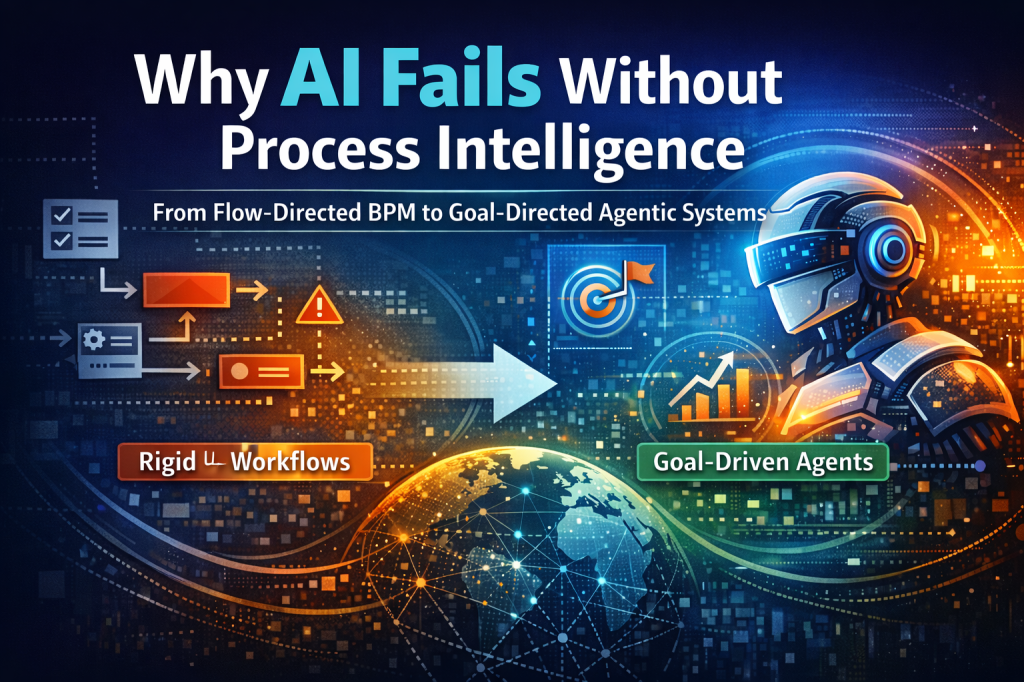
From Flow-Directed BPM to Goal-Directed Agentic Systems
The uncomfortable truth about enterprise AI
Every boardroom is asking:
“How fast can we deploy GenAI?”
Almost nobody is asking:
“What exactly are we automating?”
I’ve seen AI make responses faster and language smarter—yet outcomes remain broken.
Why?
Because AI is being plugged into workflows that were never designed to think.
Automation doesn’t fix reality — it magnifies it
There’s a famous rule:
Automation applied to an efficient operation magnifies efficiency.
Automation applied to an inefficient one magnifies inefficiency.
In the GenAI era, this becomes more dangerous:
AI applied to poorly understood processes magnifies chaos—intelligently.
That’s why process intelligence matters.
The hidden flaw in most AI initiatives
Most enterprises still rely on flow-directed processes—step-by-step, sequence-driven workflows designed for predictability and control.
(BPM—Business Process Management—is simply how organizations design and manage the way work flows from intent to outcome.)
These models worked in a stable world.
Today’s world isn’t stable.
We live in exceptions, not flows
Real enterprise work looks like this:
- Vulnerable customers
- Permit-to-Work
- Water Compliance from mutiple regulators
- Claims, outages, procurement delays
These are not linear journeys.
They are context-heavy, exception-driven, and cross-functional.
Yet we keep forcing AI to follow rigid flows designed decades ago.
That’s like asking a self-driving car to obey a printed road map.
Flow-directed vs goal-directed thinking
Here’s the shift enterprises must make:
| Flow-Directed | Goal-Directed |
|---|---|
| Follow steps | Pursue outcomes |
| Central control | Distributed intelligence |
| Predictable paths | Emergent paths |
| Humans handle exceptions | AI reasons through them |
This isn’t a tooling change. It’s a mindset change.
Where Agentic AI changes everything
Agentic AI isn’t just GenAI with tools.
It introduces:
Intent + Goals + Autonomy + Reflection
Instead of asking “What’s the next step?”
Agentic systems ask:
“What’s the goal, and what’s the best action right now?”
That’s the foundation of goal-directed processes.
BPMN isn’t dead — it’s evolving
Here’s a provocative truth:
BPMN is becoming the source code for intelligent agents.
Not as rigid instructions, but as:
- Intent
- Constraints
- Guardrails for decision-making
Processes stop commanding work.
They start guiding intelligence.
From diagrams to living systems
Modern processes must:
- Sense change
- Balance competing goals
- Adapt in real time
- Learn from outcomes
Static flows can’t do this.
But when BPM meets analytics, AI, and agent orchestration, process intelligence emerges.
A quick example (energy sector)
A flow says:
- Identify customer
- Apply policy
- Escalate
- Close
A goal-directed agent asks:
“How do I keep this customer safe, compliant, and supported right now?”
The process doesn’t disappear.
It provides direction, not commands.
Why AI agents hallucinate in enterprises
AI hallucinates most when it lacks:
- Clear goals
- Process context
- Enterprise constraints
Language fills the gaps.
Process intelligence gives AI context, boundaries, and accountability.
The future: outcomes over steps
We’re moving toward a world where:
- Work is discovered, not assigned
- Agents (human and AI) act based on goals
- Control moves to the edge
- Flows shrink into reusable snippets
Large, rigid, centrally controlled processes?
They’re becoming dinosaurs.
What leaders must do differently
If you lead technology or transformation:
❌ Stop automating broken processes
❌ Stop treating AI as a UI layer
❌ Stop confusing prompts with intelligence
✅ Invest in process architecture
✅ Define goals before flows
✅ Treat BPM as an AI enabler
✅ Design for emergence, not perfection
Final thought
AI isn’t killing BPM.
AI is exposing bad BPM.
The winners will understand:
Intelligence without process is chaos.
Process without intelligence is rigidity.
The future belongs to those who master both.

 THE AI CHRONICLE
Leave a comment