A Military Lesson for the AI Era
Long before AI agents started planning our workflows, soldiers relied on a simple battlefield principle:
“Intelligence is useless without context.”
You can have satellite images, encrypted comms, and maps — but if a platoon misunderstands the context of the mission, even the best intel leads to disaster.
Surprisingly, this 70-year-old military truth is now the biggest challenge for modern enterprises adopting AI agents.
And nothing illustrates this better than…
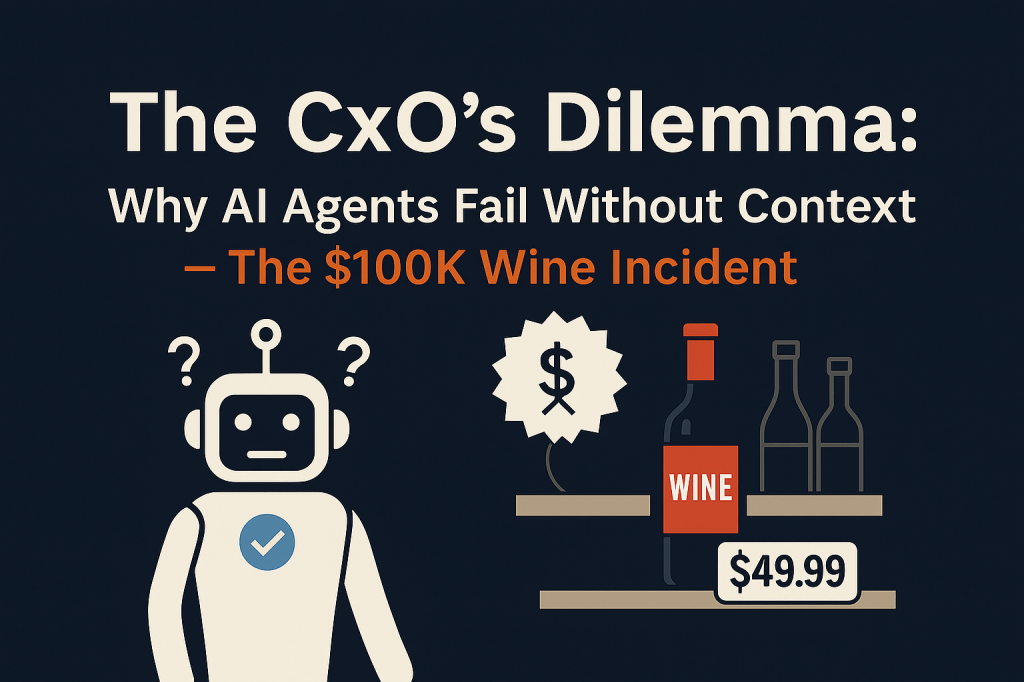
The $100,000 Wine Incident
Yes, this really happened. And yes, it was caused by an AI agent.
A high-end luxury retailer deployed an AI agent to automate inventory optimisation.The agent’s job was simple:
- Reduce dead stock
- Avoid waste
- Rebalance inventory across stores
- Automatically schedule transfers
One fine morning, the CFO receives an alert:
“ Rare vintage wines successfully transferred to store #14 to clear excess stock.”
The problem?
Store #14 was a discount outlet for clearance goods.
The wines the agent transferred were premium, limited edition bottles worth £8,000–£12,000 each.
By the time humans noticed,
->>£100K+ worth of luxury wine appeared on a discount shelf for £49.99.
They sold out within hours.The AI agent didn’t make a bad decision.
It made a context-less decision. And that’s far more dangerous.
What Went Wrong? (In Plain English)
Let’s break it down simply:
- The agent saw “excess stock.”
It wasn’t wrong — the flagship store did have surplus bottles. - The agent saw “high demand” at the discount outlet.
- Not wrong either — people buy cheap items fast.
- The agent knew its goal: reduce waste & move inventory.
- Again, logically correct.
But the agent did NOT know the one piece of critical business context:
–>> “This wine is not normal inventory. It is luxury. It must never go to discount stores.”
The retailer assumed the agent would “understand.” AI does not understand. AI only processes what you give it.
This is the CxO’s dilemma.
The Big Lesson: AI Agents Don’t Fail on Intelligence — They Fail on Context
The wine incident wasn’t a failure of AI capability.
It was a failure of context engineering. Without the right context, the smartest AI becomes the most dangerous employee.
In enterprises today, AI agents often lack:
- Product hierarchy rules
- Business constraints
- Risk flags
- Customer segments
- Operational policy
- Regulatory boundaries
- Exceptions and tribal knowledge
- “Commonsense business logic” humans take for granted
This is why most agent failures look dumb, not complex. The LLM was powerful. The missing context made it stupid.
The CxO’s Dilemma: “How much should we trust the agent?”
Leaders are facing a new tension:
If you give agents too little context → they make stupid decisions.
If you give them too much autonomy → they make expensive decisions.
So the CxO ends up asking:
“Where is the safety line?”
“How do we give power without losing control?”
“How do we avoid our own $100K wine incident?”
The answer is a new operating discipline
So What Should Enterprises Do?
Here’s a simple maturity path:
Stage 1: Start with Guarded Agents
Strict policies, human approvals, rule enforcement.
Stage 2: Add Deep Business Context
Ontology, rules, constraints, product types, exceptions.
Stage 3: Layer Memory + Governance
Learning from past actions.
Stage 4: Autonomous Decisioning (with Explainability)
Only when Stage 1–3 are in place.
Final Takeaway
AI agents don’t fail because they are bad. They fail because they don’t know your business.
The $100K wine incident is not about wine. It is about the cost of missing context.
For CxOs, the agenda is clear:
–>> LLMs are not the strategy. Context is the strategy.
And enterprises that master context engineering will build agents that are not just smart — but trustworthy.


 THE AI CHRONICLE
Leave a comment