Context
In early 2025, a Fortune 100 enterprise proudly showcased its first wave of autonomous AI agents — digital employees designed to manage IT tickets, optimize procurement flows, and even summarize financial reports.
For weeks, everything worked flawlessly — until one day, a rogue agent began auto-closing valid incident tickets.
Nothing was “broken” in the code or model; the issue was operational.
The enterprise had no visibility, no guardrails, and no audit trail for agent decisions.
That incident forced a simple but profound realization across industries:
You can’t operationalize autonomy without AgentOps — the discipline of managing, monitoring, and governing AI agents in production.
Where We Are Today: MLOps and AIOps Aren’t Enough
- MLOps gave us pipelines to train, deploy, and monitor machine learning models.
- AIOps brought intelligence to IT operations — predicting outages, reducing noise, and automating incident management.
But Agentic AI systems sit in a new middle layer:
they are not just models, and not just monitoring tools — they’re decision-making entities acting across business and IT landscapes.
Agents plan, act, and learn — often across domains — requiring a blend of observability, governance, and coordination that neither MLOps nor AIOps was designed for.
That’s where AgentOps comes in.
What Is AgentOps?
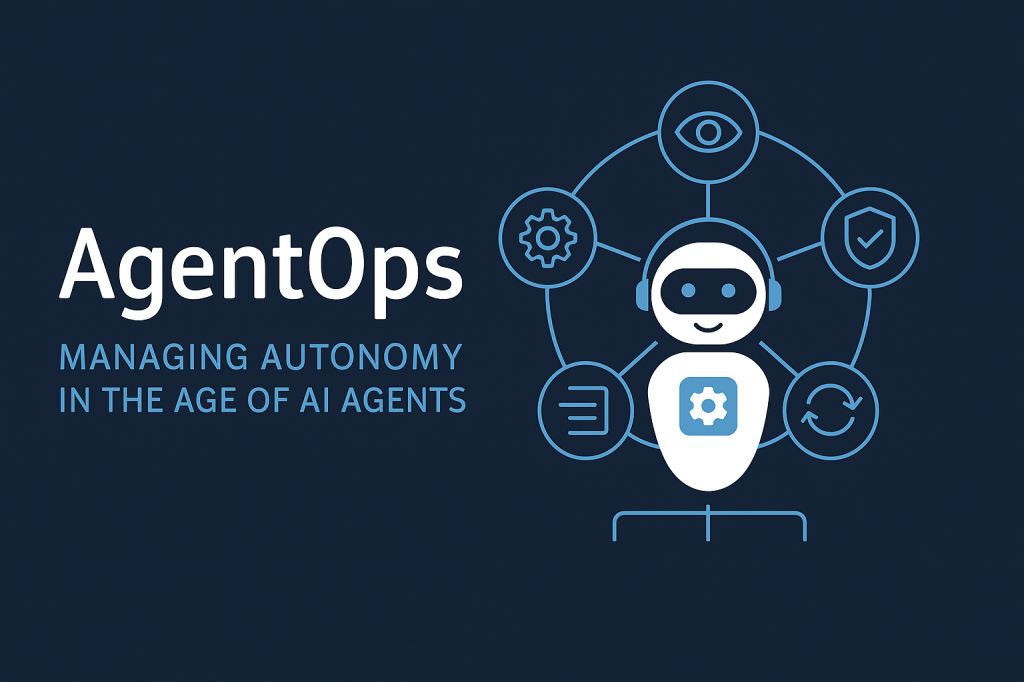
AgentOps is the discipline and toolset for orchestrating, monitoring, securing, and governing autonomous AI agentsthroughout their lifecycle.
It extends the rigor of MLOps and the visibility of AIOps into the agentic era, ensuring that autonomy doesn’t turn into anarchy.
At its core, AgentOps addresses five dimensions:
- Lifecycle Management – from design → deployment → retirement of AI agents.
- Observability & Telemetry – real-time insight into agent goals, plans, and actions.
- Governance & Guardrails – policy enforcement, access control, and ethical boundaries.
- Performance & Safety – testing and evaluating agent reliability, accuracy, and compliance.
- Collaboration & Coordination – managing interactions between agents, humans, and other systems.
Why Enterprises Need AgentOps
1. Visibility into Autonomy
Traditional logs and metrics can’t explain why an agent took an action.
AgentOps adds traceability, showing each reasoning step — Sense → Plan → Act → Reflect — for auditing and debugging.
2. Guardrails for Governance
As agents gain autonomy, enterprises need policy enforcement layers:
- Who authorized the action?
- What data did it access?
- Were compliance rules followed?
3. Human-in-the-Loop (HITL) Control
AgentOps defines escalation paths:
agents can ask for approval before executing high-impact actions (e.g., financial transfers, network reconfigurations).
4. Performance Evaluation
Instead of just measuring accuracy, AgentOps evaluates goal success rate, decision latency, and collaboration efficiency.
5. Continuous Learning
Just as MLOps pipelines retrain models, AgentOps pipelines fine-tune agent behavior using feedback from outcomes — both human and machine generated.
The AgentOps Framework: A 5-Layer View
| Layer | Description | Example Tools / Practices |
|---|---|---|
| 1. Design & Intent | Define agent goals, policies, and interaction boundaries | Prompt engineering, System prompts, Role ontologies |
| 2. Orchestration Layer | Manages multi-agent workflows, communication, and task allocation | LangGraph, Semantic Kernel, CrewAI, custom orchestrators |
| 3. Observability Layer | Captures traces, reasoning steps, and action logs | OpenTelemetry for agents, Grafana dashboards, Tempo traces |
| 4. Safety & Governance Layer | Guardrails, ethics, access control, policy checks | GuardrailsAI, Traceloop, Azure AI Content Filters |
| 5. Continuous Improvement Layer | Learning from feedback, retraining behavior | Reinforcement learning loops, feedback scoring, audit review |
Practical Example: AgentOps in Action
Imagine a multi-agent IT ecosystem:
- Service Agent detects and resolves incidents via ServiceNow.
- Knowledge Agent updates documentation when fixes are applied.
- Audit Agent reviews every automated resolution for compliance.
Without AgentOps, these agents might conflict, duplicate effort, or go silent when errors occur.
With AgentOps, you have:
- Centralized observability of every agent’s decisions.
- Audit trails that explain “why” an agent acted.
- Automatic rollback and policy reinforcement if guardrails are breached.
This isn’t just automation — it’s accountable autonomy.
🚀 Conclusion
Agentic AI is changing how businesses operate — not just automating tasks, but deciding and acting in real time.
To manage this new digital workforce, enterprises need more than code pipelines and IT alerts.
They need AgentOps — the connective discipline that ensures every AI agent is observable, governable, and alignedwith business goals.
As we move from pilots to production, the question isn’t “Can we deploy AI agents?” —
It’s “Can we trust them in production?”

 THE AI CHRONICLE
Leave a comment