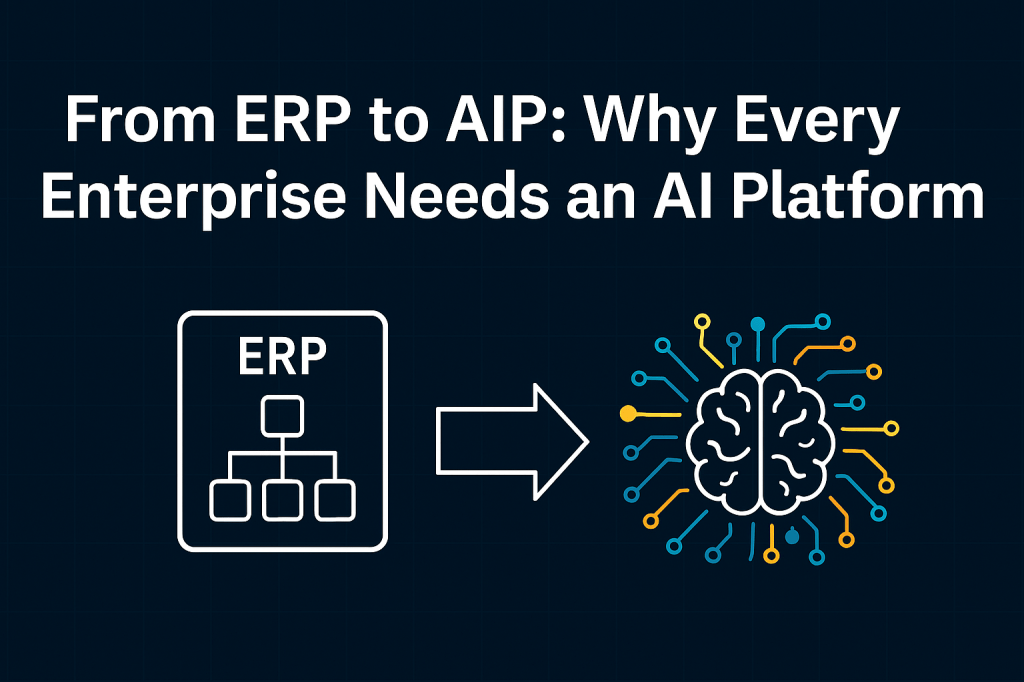
In the 1990s, enterprises faced a defining question:
Should they continue with siloed, legacy systems or take the bold leap into Enterprise Resource Planning (ERP)?
The ones who embraced ERP didn’t just streamline finance or automate supply chains. They built a backbone for scale, efficiency, and global competitiveness. ERP became the nervous system of modern enterprises.
Today, we stand at a similar inflection point. But this time, the leap isn’t to ERP. It’s to AIP — the AI Platform.
Just as ERP unified operations, AIP will unify intelligence across the enterprise — turning scattered data, disconnected models, and fragmented pilots into one cohesive, learning-driven ecosystem.
And just like the ERP wave, the choice is stark: adopt early and lead … or risk falling behind as AI-native competitors reshape your industry.
ERP to AIP: The Historical Parallel
- ERP solved integration. Finance, HR, supply chain, and operations were brought under one roof.
- AIP solves intelligence. Models, data pipelines, agents, and governance come together to make enterprises not just digital, but truly intelligent.
- Both represent platform shifts. ERP was not just software. AIP is not just AI models. Both redefine how enterprises operate.
Why Every Enterprise Needs an AIP Today
CxOs are feeling the pressure.
- Explosion of data: 80% of enterprise data is unstructured and underutilized.
- Proliferation of models: Pilots everywhere, but no single strategy.
- Shadow AI risks: Teams experimenting without guardrails.
- Scaling challenges: Productivity gains stay trapped in PoCs.
An AI Platform is the answer. It provides a single foundation for building, deploying, and governing AI at scale, with confidence and compliance.
The Core Pillars of an AIP
- Model Hub – A curated home for LLMs, domain models, and fine-tuned agents.
- Data Foundation – Pipelines, embeddings, and knowledge stores for structured and unstructured data.
- Orchestration Layer – Where AI agents, APIs, and workflows talk to each other.
- Governance & Security – Policies, ethics, audit trails, and responsible AI frameworks.
- Experience Layer – Copilots, industry apps, dashboards, and decision support.
Think of it as ERP’s “modules” reimagined — but instead of automating processes, AIP infuses intelligence everywhere.
The Business Impact
- Productivity: 30–40% efficiency gains in application development, maintenance, and operations.
- Speed: New use cases deployed in weeks, not months.
- Transformation: Industry-focused solutions — from Energy GPT balancing grids, to Construction GPT validating designs, to Finance GPT forecasting risks.
- New models: AI marketplaces and AI Agent Stores that reshape how enterprises consume and monetize intelligence.
Lessons from the ERP Era
History offers clues for today’s CxOs:
- Start small — but think platform from Day One.
- Standardize where it matters; customize where it differentiates.
- Invest in change management and talent upskilling.
- Ensure business + IT alignment; ERP failed in silos, and AIP will too.
The Call to Action
No enterprise today can function without ERP.
In five years, no enterprise will thrive without an AI Platform.
The early adopters will define new standards, new business models, and new industry benchmarks. The rest will scramble to catch up.
The ERP wave created global leaders. The AIP wave will do the same.
The only question is:
Will you be leading it — or lagging behind it?
 THE AI CHRONICLE
Leave a comment