Everyone talks about AI lifecycle management and MLOps. But when your enterprise runs on SAP S/4HANA and SAP Business Technology Platform (BTP), the conversation changes.
AI in SAP is not about stand-alone models. It’s about embedding intelligence into order-to-cash, procure-to-pay, talent management, and asset maintenance—all under strict governance and compliance.
That’s why SAP has built its own AI Lifecycle Management Framework (AILM): to ensure AI is not just developed, but also embedded, monitored, and continuously improved inside the processes that run the Intelligent Enterprise.
Why SAP Needs Its Own AI Lifecycle Model
- SAP data is structured around S/4, SuccessFactors, Ariba, Concur, and Datasphere—this requires a different approach to AI training and governance.
- SAP processes are mission-critical; downtime or bias is unacceptable.
- SAP clients operate under strict audit, transparency, and compliance obligations.
Generic MLOps frameworks don’t solve these. SAP’s AILM does.
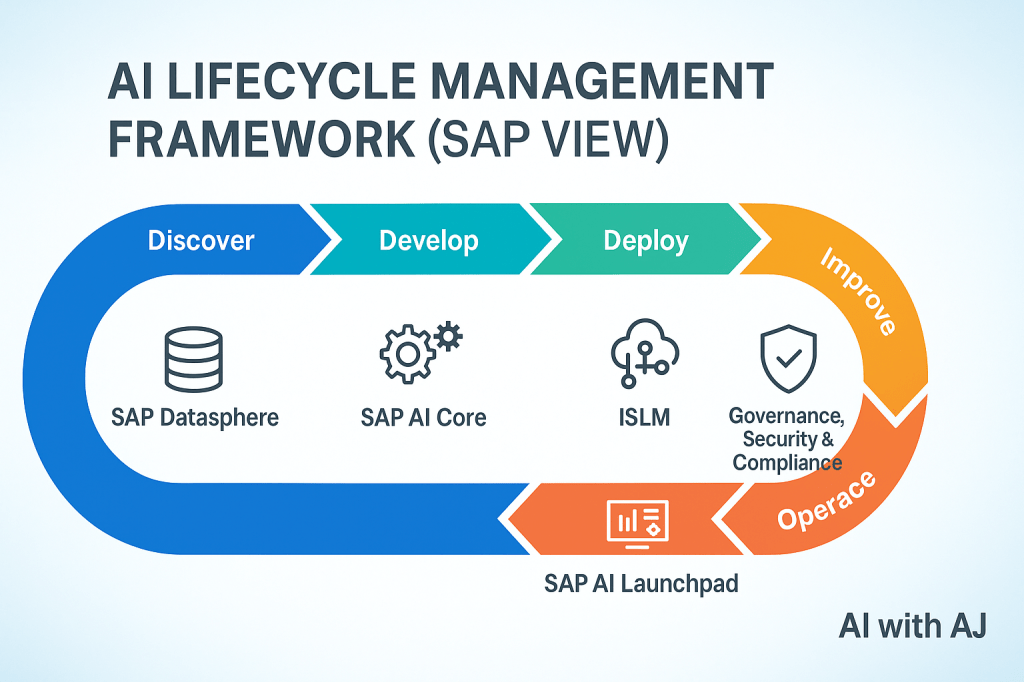
The AI Lifecycle Management Framework (SAP View)
At its core, SAP’s AILM follows a five-stage loop:
1. Discover
- Identify AI use cases directly linked to SAP business processes.
- Use SAP’s AI Business Services as accelerators.
- Tools: Best Practices Explorer, AI Business Catalog.
2. Develop
- For lightweight models → PAL/APL libraries in HANA.
- For advanced/LLM models → SAP AI Core on BTP (TensorFlow, PyTorch, Hugging Face).
- Tools: SAP Data Intelligence, Datasphere.
3. Deploy
- Operationalize via SAP AI Core and expose APIs.
- Integrate into Fiori apps, SAC dashboards, or side-by-side extensions.
- Tools: ISLM (Intelligent Scenario Lifecycle Management) to embed AI into ERP processes.
4. Operate
- Monitor accuracy, drift, and ethical compliance.
- Tools: SAP AI Launchpad for model performance, version control, and governance.
5. Improve
- Continuous retraining pipelines with AI Core.
- Feedback loops from real process data.
- Automated updates through ISLM.
This loop ensures AI is not just a proof of concept—but a living, evolving capability.
Example in Action: AI-Enabled Material Requirement Planning (MRP)
Consider Material Requirement Planning (MRP), one of the most familiar SAP processes.
Traditional MRP relies on BOMs, lead times, and demand forecasts. It’s rules-driven—and often struggles when demand is volatile or suppliers are unreliable.
With SAP’s AILM framework:
- Discover: The business goal is to improve demand accuracy and supplier reliability in procurement planning.
- Develop: A forecasting model is trained on historical demand, supplier records, and external signals using SAP AI Core.
- Deploy: The model is embedded into the MRP run via ISLM, so purchase proposals reflect AI-adjusted forecasts.
- Operate: AI Launchpad monitors accuracy and supplier risk predictions.
- Improve: Models are retrained as new data flows in.
Result: Planners move from static proposals to dynamic, AI-driven insights—reducing stockouts, avoiding excess inventory, and improving working capital.
SAP Enablers for AI Lifecycle Management
- SAP AI Core → Scalable model execution.
- SAP AI Launchpad → Central lifecycle monitoring and governance.
- ISLM → Bridge between AI models and SAP applications.
- Datasphere & Data Intelligence → Trusted data foundation.
- SAP Business AI → Out-of-the-box AI use cases ready for deployment.
Final Thought
AI in SAP isn’t about experimenting with algorithms. It’s about embedding intelligence into business processes that already run the enterprise.
With AI Core, AI Launchpad, ISLM, and Datasphere, SAP’s AI Lifecycle Management Framework ensures AI is governed, transparent, and continuously improving—exactly what the Intelligent Enterprise needs.

 THE AI CHRONICLE
Leave a comment