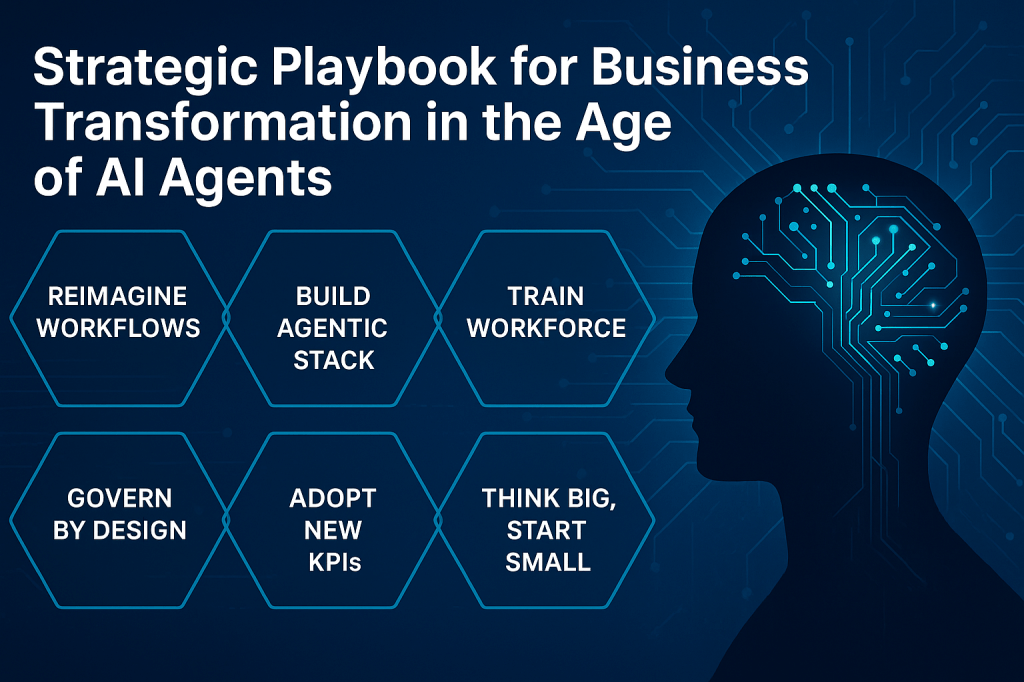
Introduction: AI Agents Are Reshaping Business Itself
AI agents are not just automating tasks—they are transforming how businesses think, operate, and compete.
They’re evolving from support tools to strategic assets. They don’t just assist people—they reshape roles, redesign workflows, and redefine value.
If cloud made IT elastic, AI agents are making business fluid.
This playbook shows how enterprises can drive true business transformation by embedding AI agents not just in tools—but in their operating model, value chain, and customer experience.
What Does “Business Transformation” Mean in the Age of AI?
Business transformation is not about digitizing existing processes. It’s about:
| Traditional View | Agent-Enabled Transformation |
|---|---|
| Automating tasks | Redefining how work happens |
| Cost reduction | Value creation at scale |
| ERP-led workflows | Autonomous, dynamic flows |
| Top-down decisions | Distributed, data-driven actions |
| Human bottlenecks | Human-AI collaboration |
How AI Agents Drive Business Transformation
1. Reimagine the Operating Model
AI agents allow you to break silos, decentralize decisions, and reshape workflows.
Examples:
- Customer support shifts from human-led to agent-first triage and resolution
- Finance operations like reconciliation or compliance become autonomous flows
- HR onboarding becomes a fully personalized, AI-driven journey
Business impact: reduced cycle times, 24/7 availability, and lower process friction
2. Redesign Organizational Roles
With agents handling repetitive, logic-based tasks, human roles evolve:
- Analysts become AI trainers and supervisors
- Managers focus more on strategy and empathy
- Employees use AI copilots to amplify their decision-making
This isn’t replacement—it’s reallocation of effort toward higher-value outcomes
3. Accelerate Speed of Innovation
AI agents can:
- Prototype new services
- Summarize market intelligence
- Generate product documentation
- Simulate business scenarios
Now every team can be faster, more creative, and insight-driven
4. Enhance Customer Experience
AI agents can engage customers across channels, 24/7, with personalized responses and contextual awareness.
From this:
“Let me escalate this and get back to you in 48 hours.”
To this:
“Based on your history and current plan, I’ve applied a 10% refund and scheduled your service call for tomorrow.”
CX transformation = higher NPS, loyalty, and digital satisfaction
5. Create New Revenue and Service Models
AI agents enable businesses to launch agent-powered services:
- Subscription-based digital assistants
- Embedded smart agents in SaaS products
- Real-time advisory agents for customers
Business model evolution, powered by agent-as-a–service
6. Restructure the Value Chain
AI agents break down linear handoffs across procurement, logistics, customer service, finance, and IT.
Instead of:
Task → Wait → Approve → Next step
Now:
Agent → Acts → Resolves → Learns
A more fluid, real-time, intelligent value chain emerges
How to Measure Business Transformation
| Metric | Traditional | Agent-Enabled |
|---|---|---|
| Cost | Cost reduction | Cost-to-serve with personalization |
| Speed | Process time | Time-to-decision |
| Growth | Product sales | New service lines via agents |
| Satisfaction | CX scores | Engagement with AI support |
| Innovation | R&D output | Features launched with agentic speed |
Final Word: Agents Are the New Org Chart
In the age of AI agents, your organization is no longer just made of people and processes.
It includes intelligent digital workers capable of owning outcomes.
Those who master this shift will:
- Move faster
- Serve smarter
- Compete bolder
- And lead transformation from the inside out

 THE AI CHRONICLE
Leave a comment