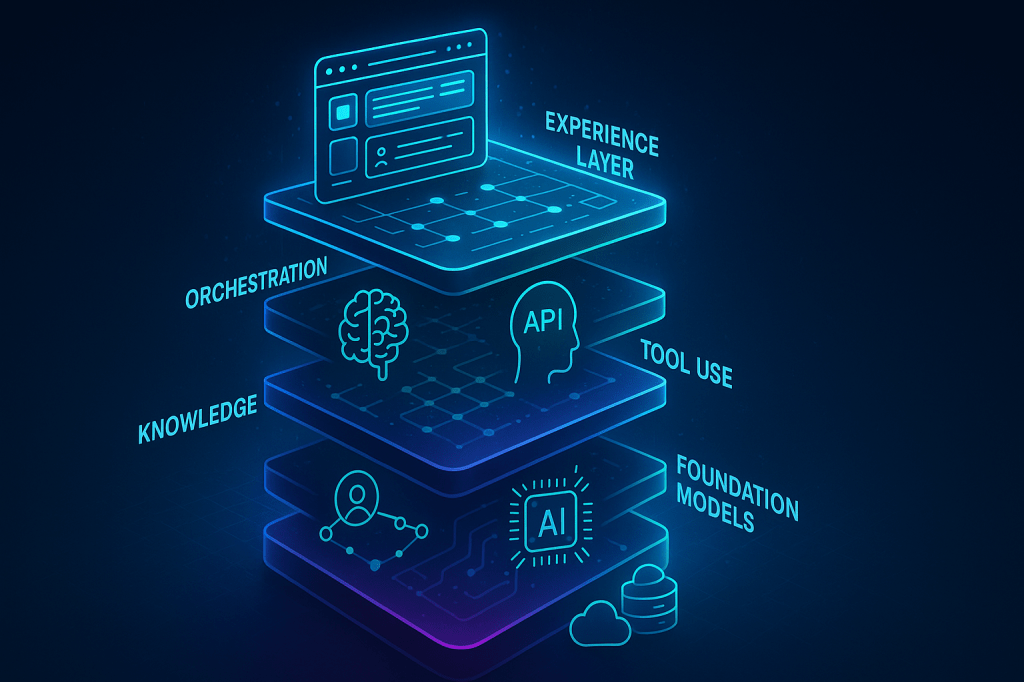
Introduction – A Familiar Structure Returns
Back in engineering college, one of the first concepts that truly stuck with me was the OSI 7-layer model—a framework that nicely explained how computer networks functioned from the physical cable to the application you used.
Each layer had a purpose. Each knew its job. And together, they made complex systems manageable, interoperable, and scalable.
Fast-forward to today: we’re witnessing the rise of AI agents—intelligent software entities capable of reasoning, planning, using tools, and interacting with humans and systems. And surprisingly—or perhaps inevitably—we’re returning to a 7-layer architecture to organize their complexity.
Why seven again? Because structured thinking never goes out of style.
Why AI Agents Need a Layered Architecture
AI agents are no longer just chatbots. They can:
- Plan and break down tasks
- Call APIs and use software tools
- Learn from prior conversations
- Personalize actions based on user profiles
- Access both structured and unstructured enterprise knowledge
As capabilities grow, so does complexity. Without clear abstraction, we risk building fragile, monolithic agents that are hard to debug, scale, or improve.
Just like in networking, a layered architecture offers:
- Modularity: Swap out or upgrade individual components
- Interoperability: Agents can talk to other systems and each other
- Scalability: Add more capabilities without breaking the foundation
The 7-Layer Architecture of AI Agents
Let’s break it down—layer by layer:
1. Experience Layer – The Interface
- This is where users interact with the agent: chat windows, voice, web apps, or AR/VR.
- Like OSI’s Application Layer, it’s the surface we see and use.
2. Orchestration Layer – The Traffic Controller
- Manages flows, multi-agent coordination, and routing of tasks.
- Think of it like the Session Layer—organizing dialogues and sessions.
3. Reasoning & Planning Layer – The Brain
- Breaks goals into subtasks, reflects on progress, and selects strategies.
- This is the AI agent’s “Transport Layer”—ensuring logical flow and reliability of action.
4. Tool Use Layer – The Hands
- Invokes APIs, scripts, or apps to take real-world action.
- Analogous to the Network Layer—navigating systems to act.
5. Knowledge Layer – The Memory Vault
- Structured (databases, graphs) and unstructured (documents) knowledge sources.
- Like the Data Link Layer—ensuring reliable access to “truth.”
6. Memory & Personalization Layer – The Context Keeper
- Tracks prior interactions, user preferences, session states.
- Much like the Presentation Layer—translating user-specific context.
7. Foundation Models & Infrastructure – The Core
- LLMs (like GPT-4), compute infrastructure, and vector databases.
- Similar to the Physical Layer—the compute, RAM, GPU, and APIs that make it all run.
Why This Architecture Matters
This 7-layer structure isn’t just a conceptual exercise. It delivers:
- Plug-and-play flexibility: Replace a planner or a tool without affecting the full system.
- Smarter collaboration: Multi-agent systems work together, each focused on specific layers.
- Faster innovation: Teams can work in parallel across layers—UI designers, model trainers, knowledge engineers.
- Enterprise-readiness: Layers like memory and orchestration allow for compliance, observability, and control.
Conclusion – History Repeats, with Intelligence
In the 1980s and ’90s, the 7-layer OSI model helped build the internet. Today, a similar 7-layer framework is quietly shaping the intelligent agents that will drive our next revolution.
Layered thinking brings clarity to complexity, interoperability to innovation, and scalability to systems.
And yes—seven still seems to be the magic number.
 THE AI CHRONICLE
Leave a comment