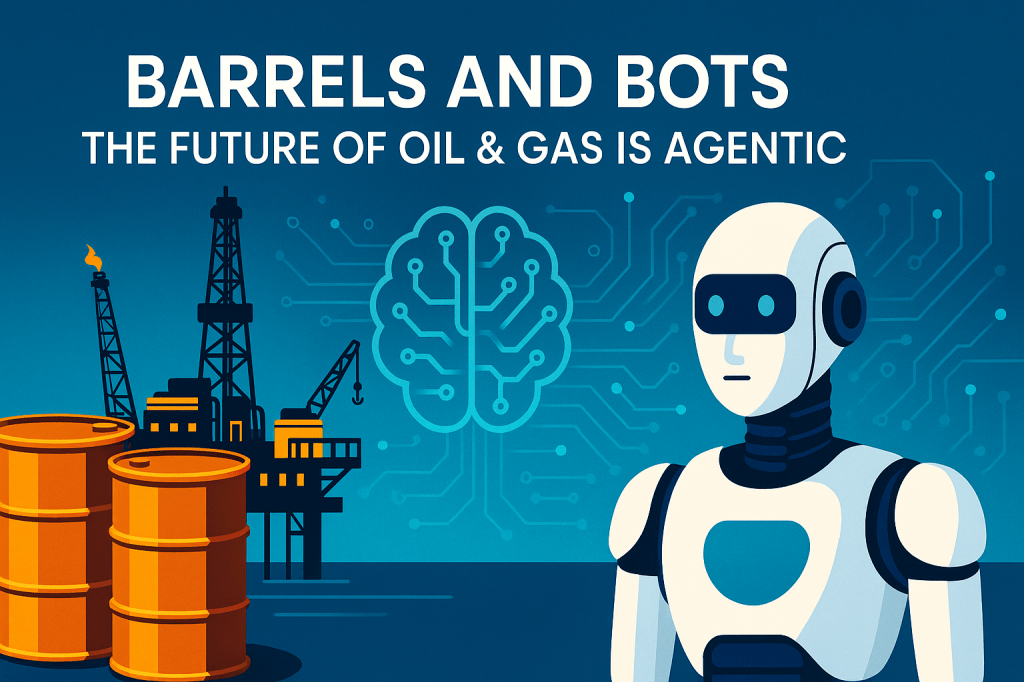
It’s 3 a.m. on an offshore platform in the North Sea. No human is on deck — just a fleet of autonomous AI agents monitoring pressure valves, analyzing seismic shifts, and predicting mechanical failures before they happen. The command center? 1,000 miles away, where engineers collaborate with Gen AI copilots translating real-time field telemetry into actionable insights. Welcome to the age of the agentic oilfield.
A Sector Under Pressure — And Primed for Intelligence
The oil and gas industry is under mounting pressure — not just from price volatility and supply chain disruptions, but also from decarbonization targets and investor scrutiny. For decades, the sector has leaned on industrial automation, digital twins, and remote operations to drive efficiency.
But now, a new wave of transformation is emerging — powered by Agentic AI, where autonomous software agents not only assist, but act, adapt, and optimize on behalf of humans. These agents are the next leap beyond automation, bringing reasoning, memory, and real-world decision-making to the energy landscape.
🤖 What Is Agentic AI?
Unlike traditional AI that responds to direct prompts, agentic AI operates with autonomy, purpose, and persistence. These AI agents have the ability to:
- Perceive the environment (via data streams)
- Plan actions based on objectives
- Act with minimal supervision
- Learn and adapt from feedback over time
In oil and gas, this means evolving from static dashboards to dynamic digital workers — copilots, supervisors, and virtual field engineers that collaborate across the value chain.
How Agentic AI Is Reshaping Oil & Gas
1. Upstream Intelligence
AI agents now simulate thousands of reservoir models, analyze seismic data, and generate drilling plans — faster and more accurately than human teams. Autonomous drilling platforms, supported by Gen AI copilots, optimize decisions in real time, reducing downtime and non-productive time (NPT).
2. Midstream Monitoring
Smart agents patrol pipeline networks, detecting leaks, abnormal pressure variations, and cyber threats. With Gen AI, these systems generate explanations and suggest mitigation strategies — helping operators act before issues escalate.
3. Downstream Optimization
Refineries are becoming self-optimizing. AI agents adjust temperature, pressure, and flow in complex distillation units based on live sensor data, balancing energy efficiency with output quality. These agents also coordinate maintenance tasks to avoid unplanned shutdowns.
4. Enterprise Transformation
Behind the scenes, Gen AI copilots are embedded in SAP, procurement, and finance systems, answering queries, summarizing reports, and orchestrating workflows — turning every knowledge worker into a decision-maker.
A Hypothetical Glimpse: PetroNova’s Agentic Field
PetroNova, a mid-sized upstream company, deployed a multi-agent system across its offshore fields. One agent monitored drilling performance, another optimized mud circulation, while a third managed spare part logistics with predictive restocking.
The result?
- 35% reduction in unplanned downtime
- 20% improvement in drilling accuracy
- Faster incident response with zero manual intervention
These were not standalone bots — they collaborated like a digital team.
Challenges on the Horizon
Agentic systems require:
- High-quality, real-time data from sensors, ERP, and external sources
- Governance frameworks to ensure safe and explainable actions
- Cybersecurity and fail-safe mechanisms for mission-critical operations
Oil & gas is safety- and compliance-critical — agentic AI must be held to the highest operational standards.
Conclusion: From Oil Barrels to Autonomous Bots
We are witnessing a paradigm shift. The unit of measurement may still be barrels, but the true value is increasingly extracted by bots — intelligent, collaborative, and autonomous.
In the future of oil & gas, every barrel will come with a bot — not to replace humans, but to empower them.
 THE AI CHRONICLE
Leave a comment