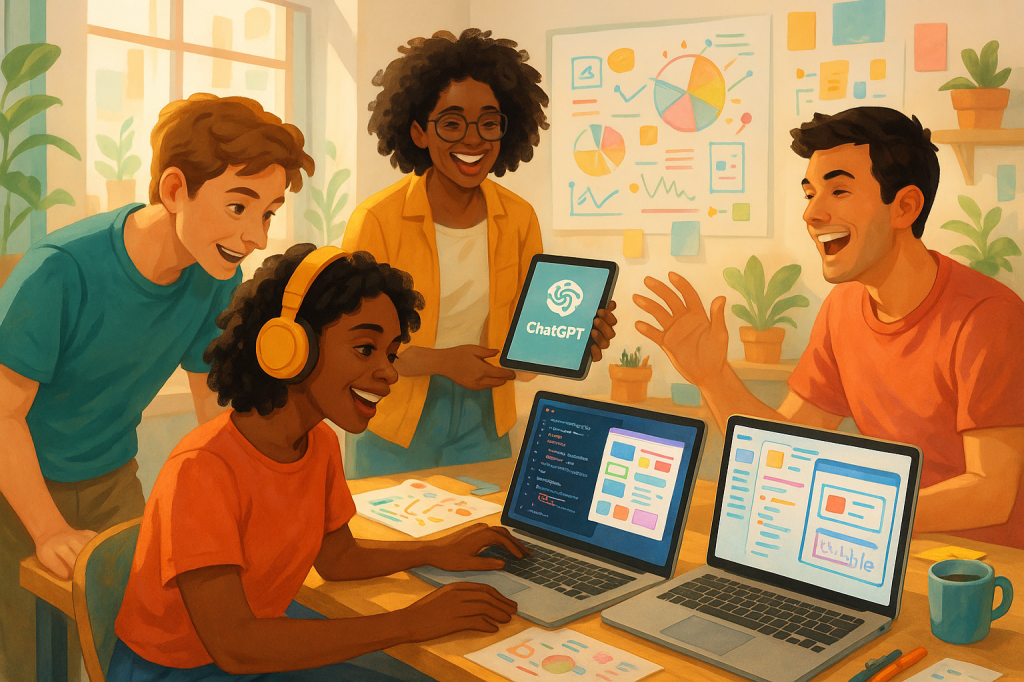
Inspired by creativity and fueled by curiosity, vibe coding is here to make programming feel less like math class and more like music.
Let’s be honest—coding sounds intimidating to a lot of people. Rows of complex syntax, scary error messages, and a steep learning curve can make it feel off-limits to the average person.
But what if I told you: coding doesn’t have to be stressful—it can be a vibe?
Welcome to vibe coding. It’s not about knowing every keyword or data structure. It’s about feeling your way into technology, starting with a creative idea, and letting tools—especially AI—help you build from there.
What is Vibe Coding?
Vibe coding is the new gateway to tech—creative, casual, and co-built with AI. It’s less “write this function line by line” and more “describe your dream app and let the machine help you create it.”
Here’s what it looks like:
- Describe what you want, and AI writes code for you (ChatGPT, GitHub Copilot).
- Drag-and-drop tools like Bubble, Power Apps, or Glide to build apps visually.
- Creative play through Scratch or MIT App Inventor.
- No fear of messing up—just try, tweak, and explore.
Why It’s Made for Non-Coders
Vibe coding works for the dreamers, creators, and first-time builders:
- You don’t need to memorize code—just describe what you want.
- You get instant feedback, helping you learn as you go.
- It’s collaborative, not isolating—you and AI are co-creators.
- It invites you to build real stuff, not just toy projects.
Inspiration from Asha’s Story: From Sketchbook to App Store
Asha, a 42-year-old art teacher, had never written a line of code in her life. But when her students struggled with remote learning, she imagined a simple app—something playful, motivational, and visual.
At first, coding felt out of reach. She almost gave up.
But then she found Thunkable, a no-code builder, and paired it with ChatGPT to guide her logic.
In one week, she had an app prototype.
In one month, her class was using it to submit artwork and get feedback.
Asha didn’t start with code.
She started with care.
That’s the heart of vibe coding—where intuition, emotion, and intention meet technology.
Real-World Vibe Coders
- A teacher builds a math quiz chatbot using ChatGPT and Typeform.
- An entrepreneur automates customer emails using Zapier.
- A student creates a mobile pet-care app with MIT App Inventor.
- A content creator designs a portfolio site using Framer AI.
They all started with an idea, not a textbook.
Start Your Vibe Coding Journey
- Think of a story or problem you care about.
- Use ChatGPT or Replit Ghostwriter to describe your idea and get code.
- Try a visual platform like Bubble or Power Apps.
- Learn by remixing—copy code, play with it, and make it yours.
You don’t need to code like a pro to build like a boss.
Closing Thought
You were told coding is for the chosen few. Vibe coding says otherwise.
If you can imagine it, you can build it.
And with a little help from AI, your vibe might just change the world.

 THE AI CHRONICLE
Leave a comment